(CONGREGATIONALIST, THEN PRESBYTERIAN, NOW COPTIC ORTHODOX)
Lyttelton Street, Castlemaine
Pinnacled and picturesque in its place on a hill.
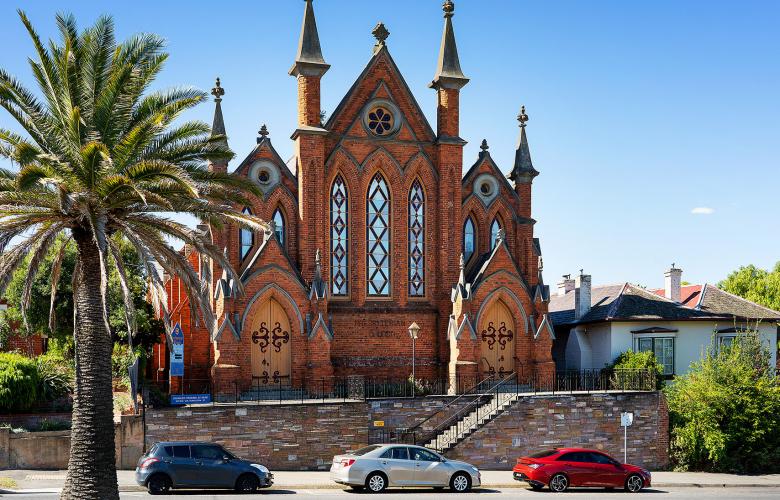
Exuberant is one word to describe the architecture of the Castlemaine Presbyterian church, the first of the big four churches in the centre of this handsome Victorian town to fall out of use. Its four-pinnacled profile rises high on a hill, where its gables and assemblage of lancet and rose windows, and its sprightly porches on either side – all cheerfully “incorrect” by the canons of Gothic design – give it the air of a set for Lohengrin, an effect reinforced by the theatrical patterns in coloured glass in the windows.
The church was built not for the Presbyterians but for the Congregationalists, a denomination subsumed into the Uniting Church in 1977. This amalgamation was not entirely harmonious. Not all Presbyterians agreed to the merger, and when their church, across the street from the present one, was appropriated to the use of the new Uniting Church, the “continuing Presbyterians” moved into the former Congregationalist church. There they stayed until 2021, when, for the usual reasons of age and decline, the building became too much of a burden for its congregation to maintain and was put on the market. It was sold for $2.37 million to a property company named Heavenly Trio – why do developers and estate agents persist with these toe-curling puns when selling up churches? – the trio being the church, its manse and the original Congregationalist church next door, a simple Georgian building of 1855.
All three buildings are “heritage-listed”, not that that will do them much good when the conversion to other uses gets under way. According to the new owners the “other uses” permitted by “heritage” and council laws include “conversion to residential, short-stay accommodation, childcare, commercial, a community centre or a place of assembly” (whatever that is). In other words, there’s almost nothing the church can’t be turned into, and this illustrates the fundamental difficulty of converting churches into something else. Whatever their new purpose they continue to look like churches, as do town halls, post offices, railway stations etc. adapted to other uses, so that the building never looks right for its revised secular function. (Some characterless “contemporary” churches might be an exception to this.)
The other difficulty is that unless the church is adapted with a minimum of alteration as, say, a public hall, its ecclesiastical interior will be, not to put too fine a point on it, wrecked. It will be carved up with partitions, false ceilings and mezzanines, obliterating its original identity. This rather defeats the purpose of giving the church “heritage listing” in the first place, if only the outside is to be preserved. The listing would seem to be more for the benefit of the building’s place in the “streetscape” than for the building itself.
Churches are always best preserved as churches, and now that most Australians have given up going to church that has usually meant finding an Orthodox or Coptic* or other “ethnic” congregation without a church of its own. But most of those are already provided for. Yet very few churches have become mosques for what current levels of migration must be making the fastest growing religion in Australia. Perhaps Islamics don’t want their places of worship to look like churches.
The Castlemaine Presbyterian church was built in 1861-62 to a design by William Spencer (or Spenser), about whom little is known. It is a “hall church”, that it, with a central nave and side aisles divided from it by columns but no clerestory above. The building material is red brick. Compared with the flamboyance of the façade the sides and back of the church are subdued.
The remaining Presbyterians have moved to a school chapel on the outskirts of the town. The fate of their unusual church is yet to be determined by Heavenly Trio.
UPDATE 5.12.2033.
- This church has been leased by the Coptic Orthodox diocese of Melbourne for use by a new parish. It is thus spared, for now, the mutilation of “redevelopment”. (Information kindly supplied by Dr Paul Tankard, University of Otago, New Zealand).
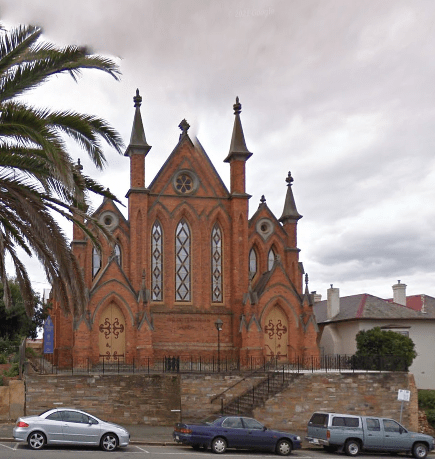
 HERE TODAY...
What a pleasing result. Were I one of Castlemaine’s Presbyterians, the charms of this church would tempt me to consider the claims of Coptic Orthodoxy.
LikeLike