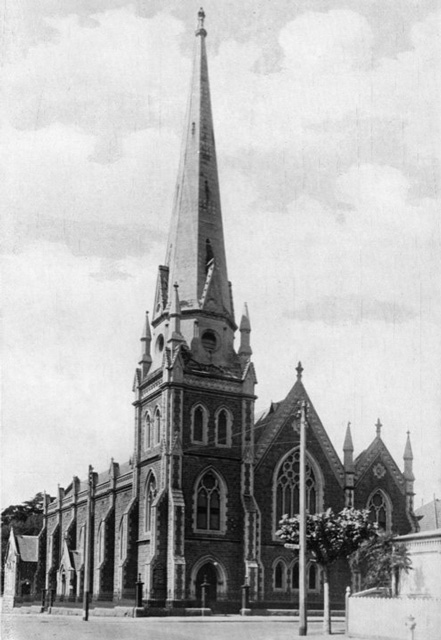
(CORNER BARKLY STREET AND ALMA ROAD, ST KILDA)
For sale after 170 years.
It looks as though redundancy might finally have caught up with St Kilda’s splendid Presbyterian church, a church already once snatched from the jaws of closure.
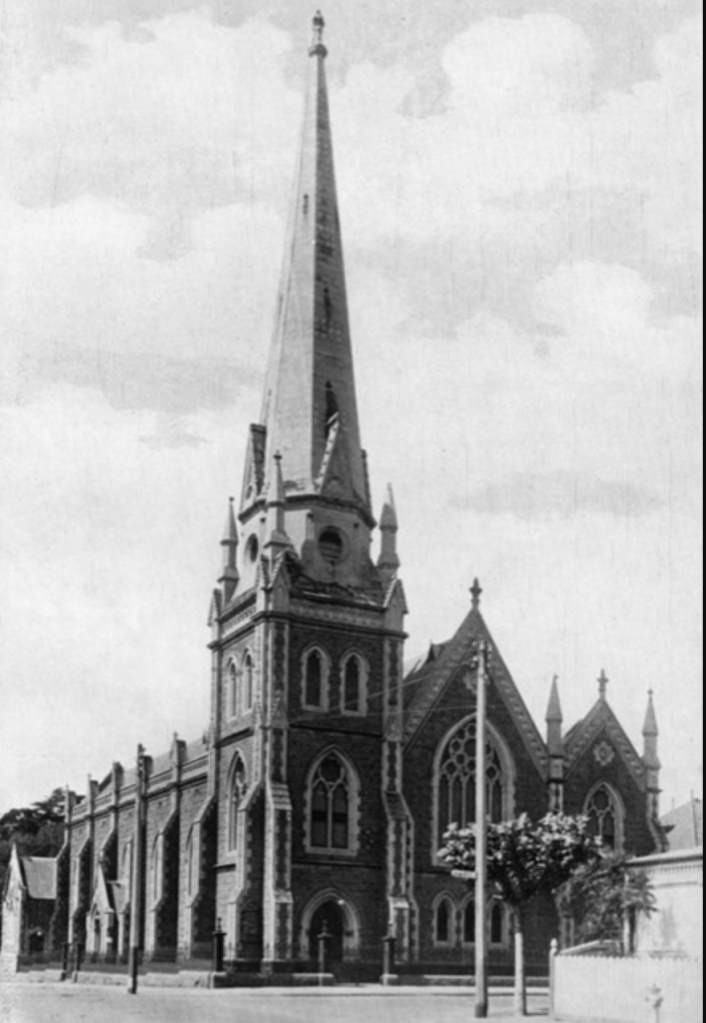
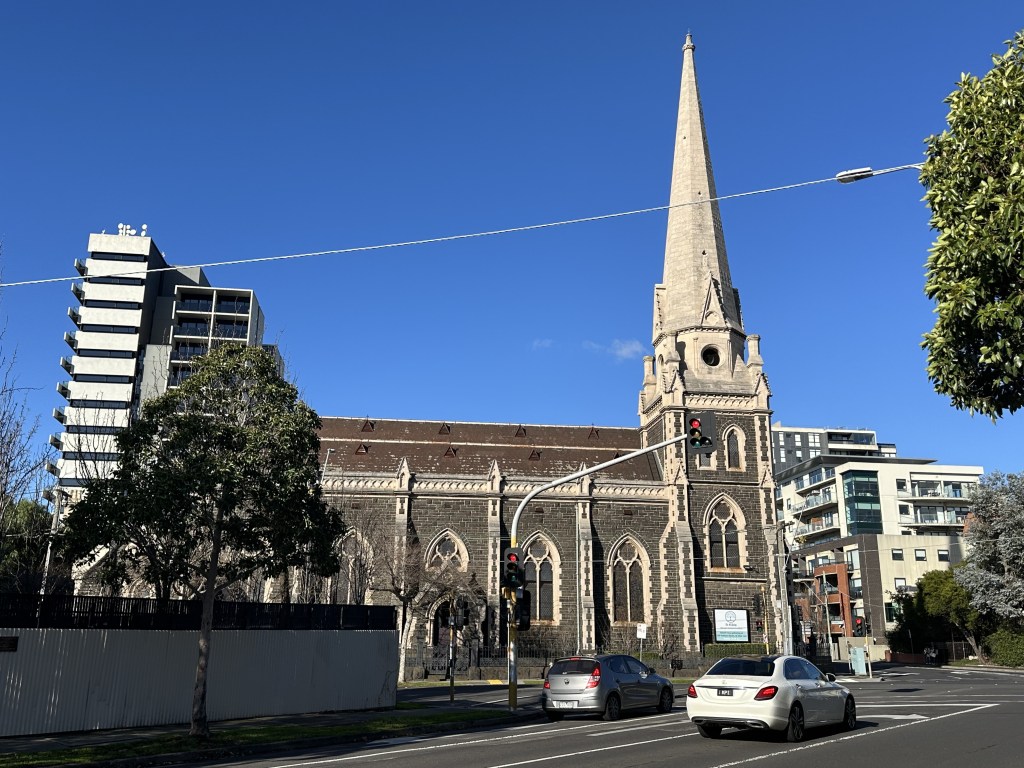
With its soaring 142-foot spire a landmark visible from all over the district, this church is the most prominent building in St Kilda, just about holding its own against the challenge of several recent tower blocks of flats. From out to sea the profiles of the spire and the similarly impressive campanile of the Sacred Heart church in Grey Street give the St Kilda skyline its distinctive character. (The Anglican church, Christ Church, was to have had a spire too but never got one, and with a congregation of 30 is unlikely to get one now.)
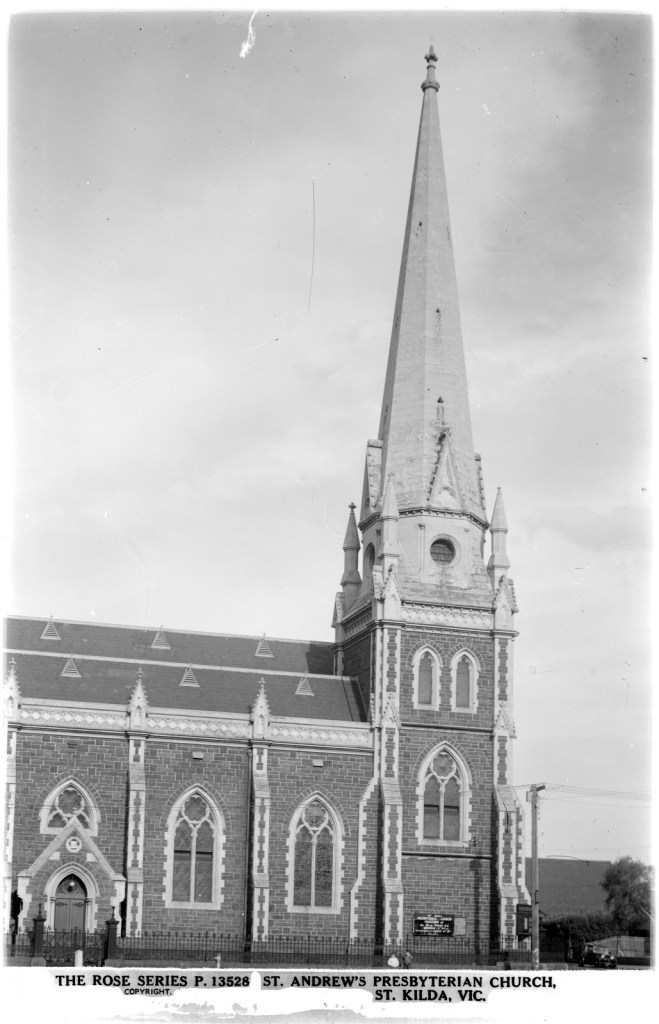
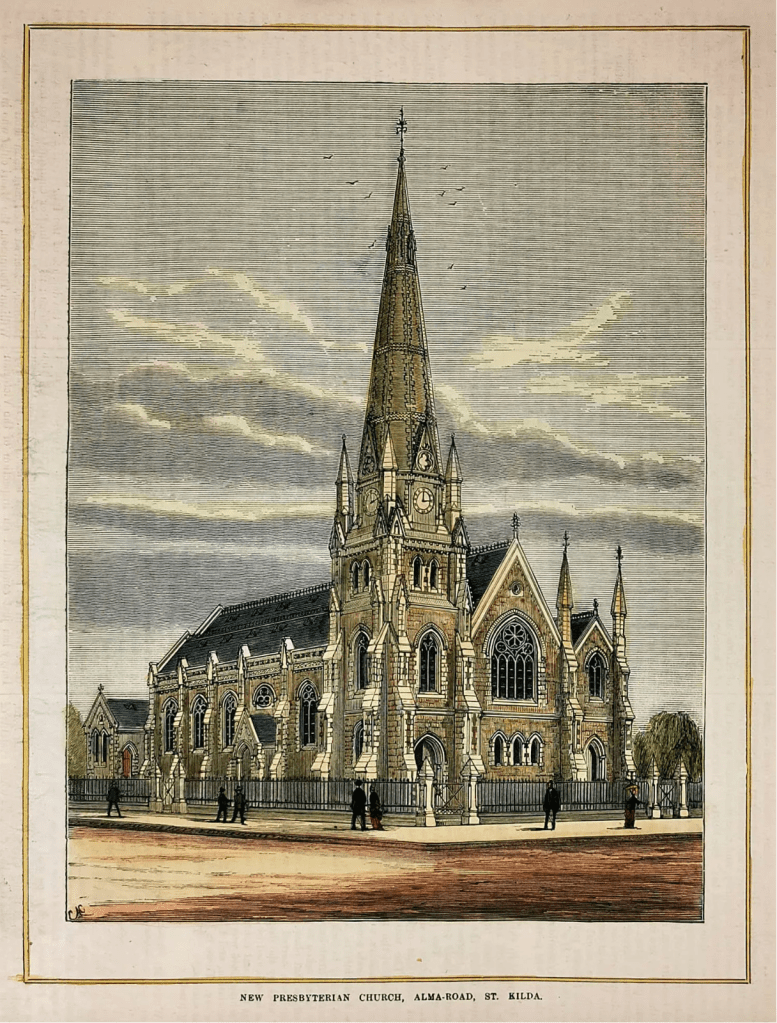
The St Kilda Presbyterian church was built in 1885-1886 of bluestone with freestone dressings. The architects were the partnership of Wilson and Beswicke, formerly Crouch and Wilson. The style was a version of English Decorated Gothic and the size of the building testament to the numbers and wealth of Presbyterians in St Kilda at the time. The exterior is dominated by the tower and spire, imaginatively placed right on the hill crest above the intersection of three busy streets. The tower has corner pinnacles (now missing their conical caps) and circular clock openings placed beneath Gothic gables but without any sign of a clock – was there ever one?
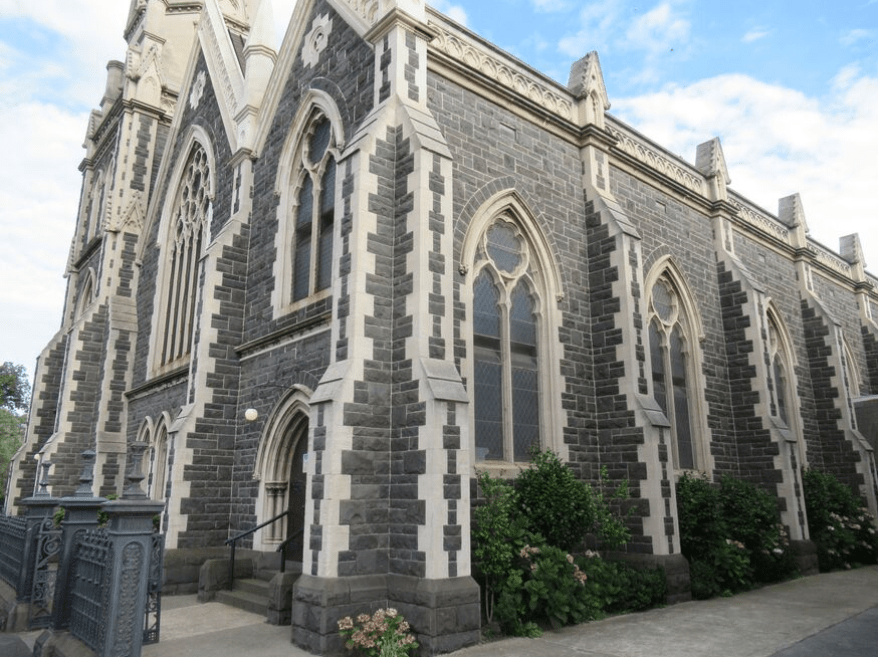
The building is unusual in Australia for being a “hall church”, that is, a church with a nave and aisles of about the same height, separated by arcades but without clerestory. Two of the relatively few other examples are actually close by – All Saints’ in East St Kilda and Christ Church, South Yarra. The nave terminates in an apse with communion table and elders’ stalls.
At some point the church was known as St Andrew’s – St Andrew is the patron saint of Scotland and many Presbyterian churches carry that dedication – but has for years been known by its locality.
The following description of the interior of the church by John Maidment in the Organ Historical Society of Australia’s Gazetteer cannot be bettered.
The spacious hall-church interior, with lofty aisles, broad nave and raked floor, focusses upon a large apse whose ceiling (like The Scots’ Church in the city of Melbourne) was once embellished with stars. At the rear there are twin porches and a narthex with a staircase to the rear gallery where the choir and an earlier organ were initially housed. The aisles are divided from the nave by tall cast iron columns with floriated capitals; this material is also used for the balustrading of the gallery and pulpit as well as the external fence and gates.
The building is lit by large Gothic windows with geometric tracery. They incorporate glass by the following craftsmen: in the apse, Ferguson & Urie, depicting Faith, Hope and Charity; on the west side, at the rear, Ernest R. Suffling, Edgware Road, London (signed) c.1892; and two windows to the front, the first by Mathieson & Gibson, of Melbourne (signed) inserted in the 1930s and a second, to the left, probably by Brooks, Robinson, inserted in 1949. To the east there is a splendid window by the renowned artist Napier Waller, dating from 1950, of interest for its stylised faces and leaf patterns. The remaining windows have quarry glass with coloured borders.
The woodwork in the church is of particular note. The magnificent pulpit, in polished kauri with blackwood detailing, incorporates intricate relief panels, splendidly carved by John Kendrick Blogg, depicting the burning bush, wheat ears, grapes and St John’s lilies. In the narthex there is a First World War memorial finely carved in Tasmanian blackwood. The cedar pews incorporate ends of unusual design with turned columns and enamelled location plaques; the central section is divided. The ceiling is of tongue and groove boards laid diagonally.
The effect in the days when the church was full every Sunday must have been striking.
The threat of closure has hung over the St Kilda Presbyterian church for quite a while. For some time in the 1990s it actually was closed, until reopened by a small returning congregation. Soon after that, its Gothic stonework, particularly on the high gable ends that are most exposed to St Kilda’s maritime weather, was found to be deteriorating to the point of being unsafe. The worst damage was restored and paid for by insurance.
Around about the same time the elaborate painted decoration of the interior was restored. The result was one of the most impressive Gothic structures in Melbourne – not exactly beautiful, its architectural detail not being fine enough for that, but imposing.
With the building in reasonable condition again, there seemed no reason why the church’s small congregation could not continue to worship there for the foreseeable future. The difficulty has arisen because of the cost of maintenance, the need for further expensive repairs and the increased cost of insurance. It was therefore decided to merge the congregation with that of the Presbyterian church in East St Kilda, a rather good example of the “contemporary” church architecture of the 1950s (and built at a very late date for a new church in a very unPresbyterian suburb).
With its congregation now worshipping elsewhere, the future of the big church on the hill is undecided. Can it be reopened? Or will it have to be sold?
If the latter is the only alternative, it is reassuring that the minister and congregation say they would prefer that the building be taken over by another religious body, perhaps one of the “ethnic” churches that flourish in various parts of Melbourne. Conversion to a concert hall or “arts hub” (like the Neil Street Uniting church in Ballarat) would be a possibility although there is little space around it for car parking. The worst outcome would be conversion into apartments, with its fine interior carved up and partitioned and dormers and other excrescences on the roof, a fate which several important churches in Melbourne have not been spared, most notably the fire-gutted, also formerly Presbyterian, Cairns Memorial church in East Melbourne.
UPDATE 3.12.2024: Yes, the St Kilda Presbyterian church is to be sold. The boards have gone up, describing the church in the usual estate agents’ jargon as “unique” and ‘iconic” and spruiking its “endless possibilities” for conversion to luxury apartments, etc. What an indignity, not to mention architectural loss. At a price of three million dollars, no other congregation could afford this building, even if one could be found.
UPDATE 26.5.2025: The church has been sold, presumably to property developers, and is now undergoing a “heritage” assessment with a view to being converted to – what else?– apartments. No matter how sensitively the conversion is carried out, the fine interior will be lost, and heaven knows what will happen to the artistically important stained glass.
With the closure of the Alma Road church, only two churches are left in this western part of St Kilda, the Roman Catholic in Grey Street and the Anglican in Acland Street, both, particularly the Anglican, hanging by a thread. The Catholic has lost its independent parish and the Anglican has a very low attendance. If you’ever wondered what the post-Christian world will look like, come and see it in St Kilda.
 HERE TODAY...