HOLY TRINITY, SEBASTOPOL

(ANGLICAN)
ALBERT STREET, SEBASTOPOL, BALLARAT

Roof repairs beyond the parish resources.
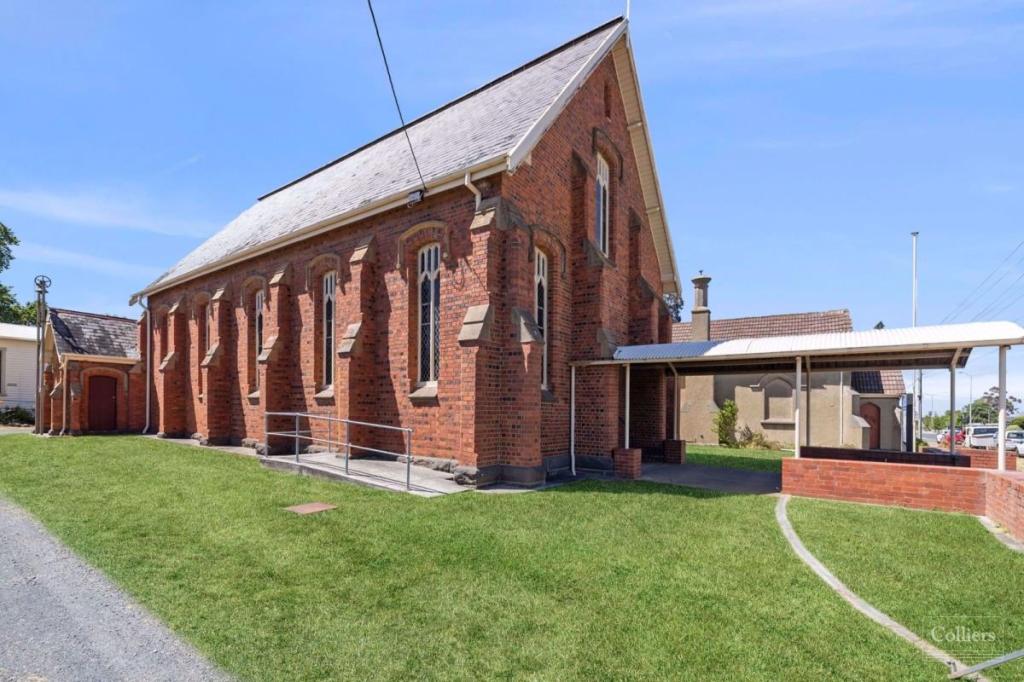
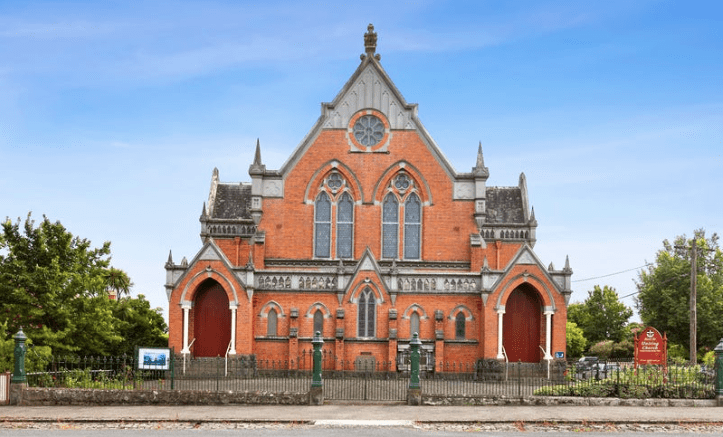
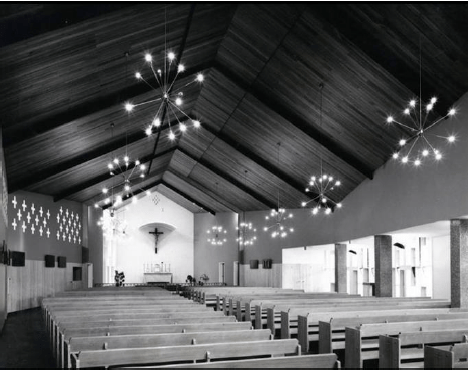
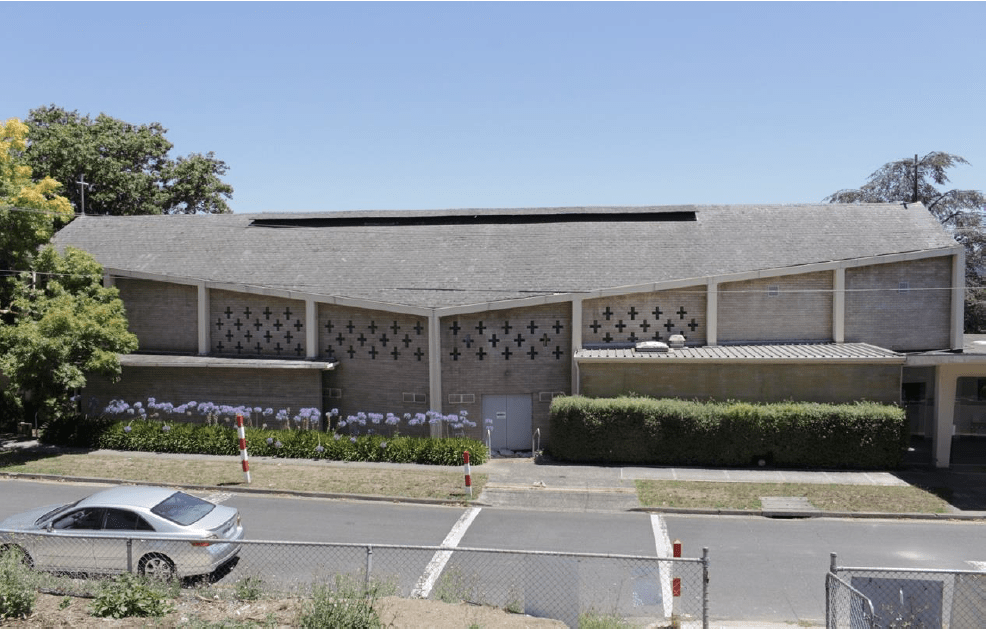
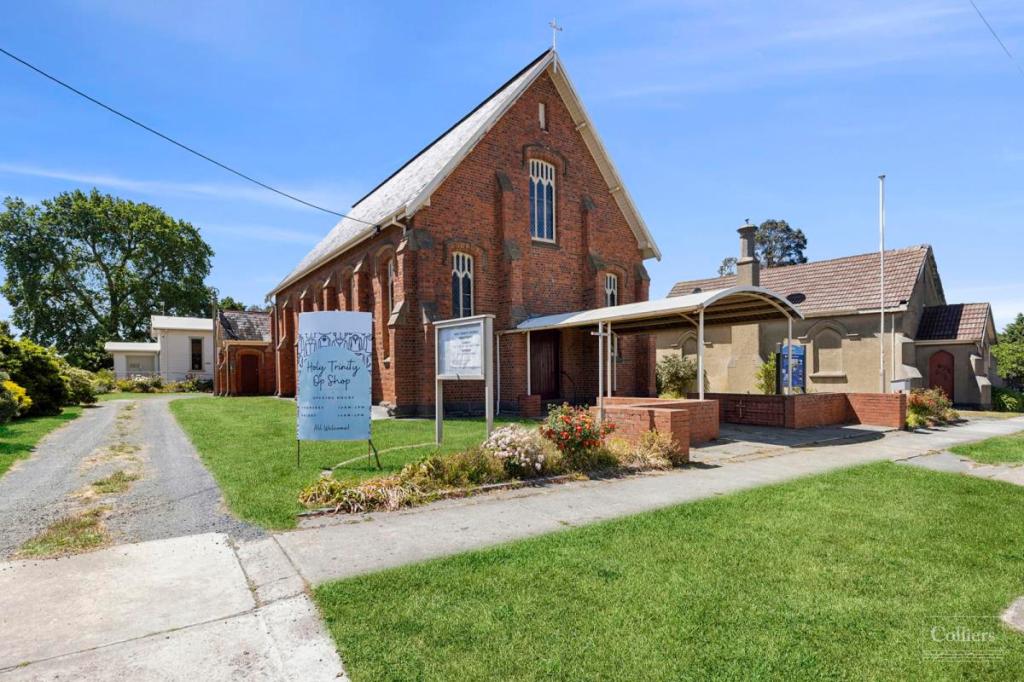
Exterior and (below) interior of Holy Trinity, Sebastopol, Ballarat. (Photograph courtesy of Colliers International.)

Well, at least it’s not going to be Heavenly Pizzas or an “Arts Hub”.

Sebastopol Anglican church, Holy Trinity, on the southern fringe of Ballarat, has been sold to a Sikh group, who will use it as a centre for their community. From Anglicanism to Sikhism in a provincial city’s suburbs is a fairly good illustration of our nation’s current demographics.
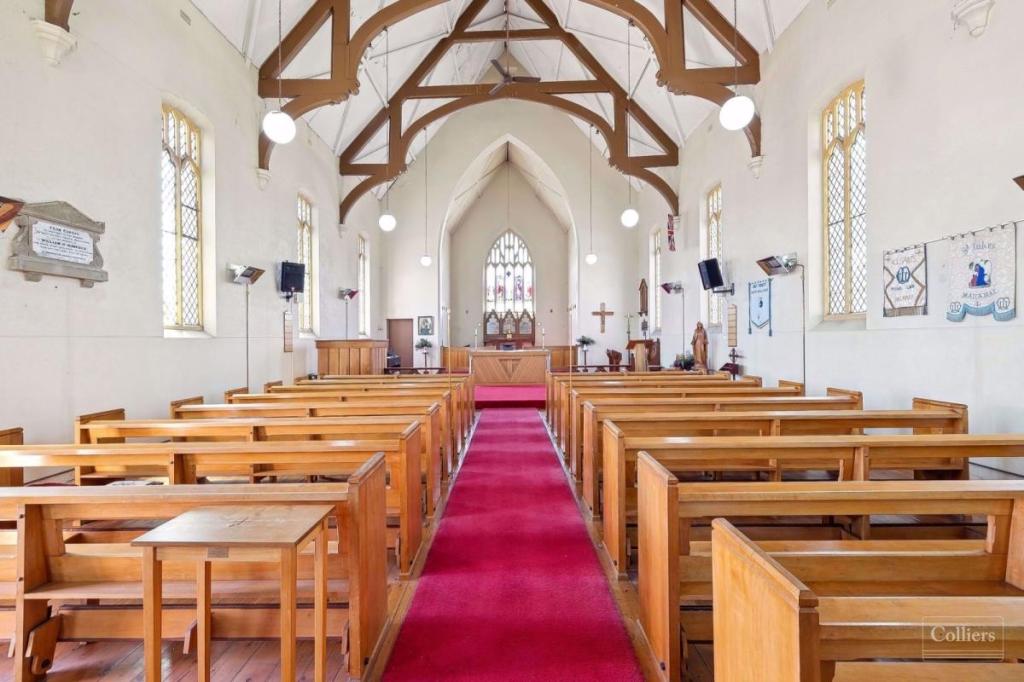
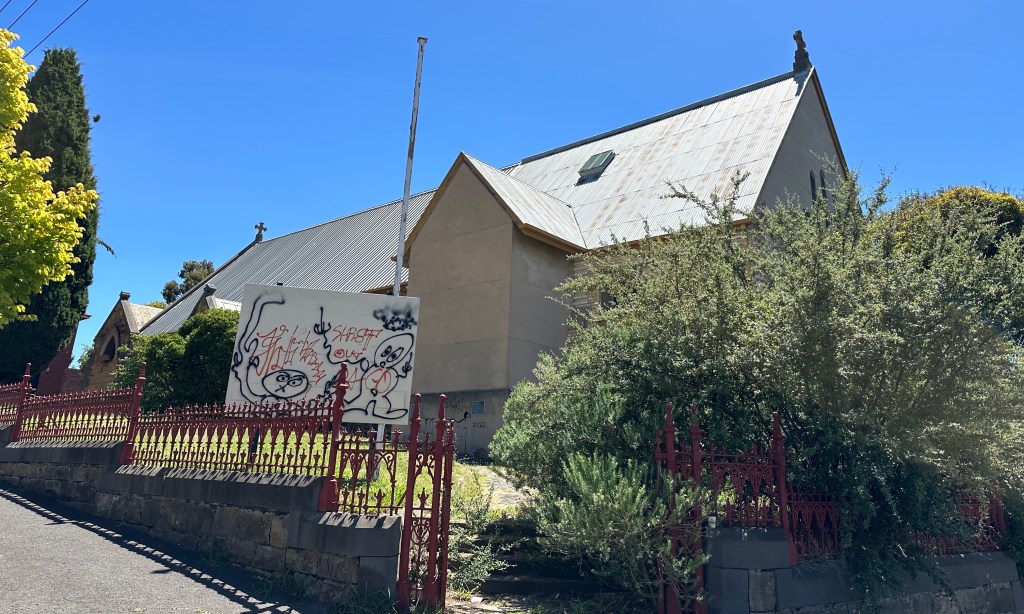
Holy Trinity wasn’t put up for sale for the usual reason – that nobody much went to it. It had an active parish life, a reasonable-sized congregation and even – a rarity these days – some younger families and their children. The problem was the roof, not of Holy Trinity itself but of the 1850s stuccoed-brick former church beside it, now used as a parish hall. This had been damaged in a storm and needed expensive repairs that were beyond the resources of the parish and, presumably, the insurance payout.  
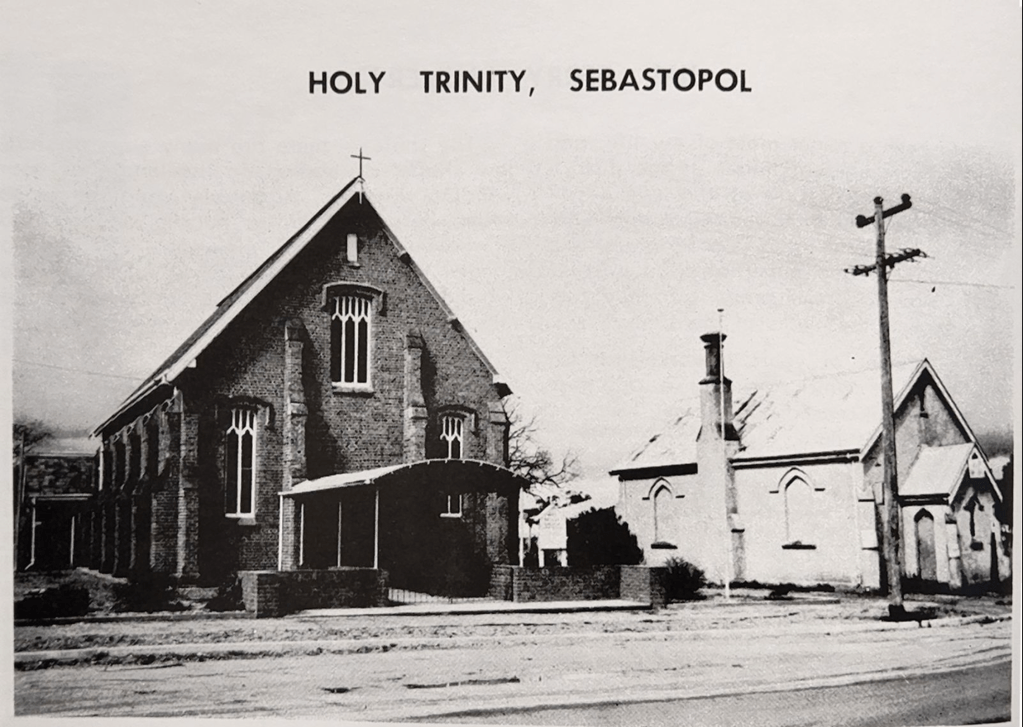
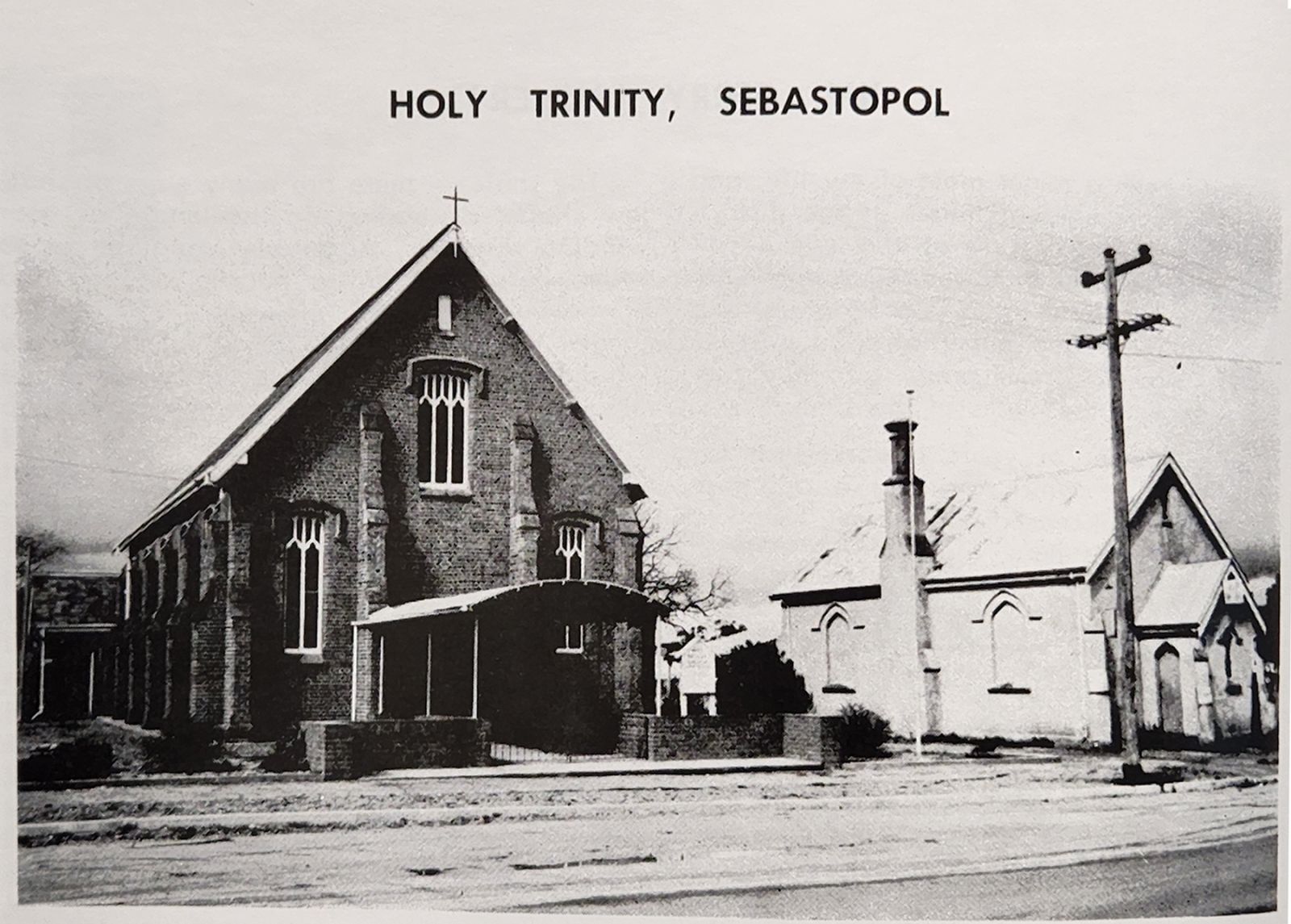
Holy Trinity replaced an older church beside it. https://www.hulballarat.org.au/cb_pages/images/Discover%20Historic%20Sebastopol/Photo%2012_%20Holy%20Trinity%20Church.jpg

The following information has been contributed by local historian Dr Juliette Peers. 

“The major problem was the roof repairs in the 1850s original church, which had become unusable due to storm damage. Equally the historic nature of the building was a problem, bringing with it the difficulty and expense of sourcing roof slating to replace the 1930s and 1950s asbestos roofing, the latter substance demanding again more specialist treatment which is equally expensive although not so visually glamorous as historic restoration. All of which had put repairs beyond the funding that a congregation and sausage sizzles could reach. These complex problems were the tipping point for the Anglican diocese in its decision to sell the site despite the relative health of the congregation.


“The Holy Trinity church complex was noticeably attractive with its early church of the 1850s and a later moderately grand Church – very swish for a working class mining community – in the rather strong and bright orangey red brick that characterises much 1850-1890 brick construction in Ballarat and has a vibrant tone not seen in Melbourne brick and clays. The church was not very “high” (Ballarat is a largely Anglo-Catholic diocese) but has colourful windows and woodwork of a high quality. Behind it is a much later and rather utilitarian timber hall and there’s little bit of cottage-garden planting. 

“So much community love and energy in there.”
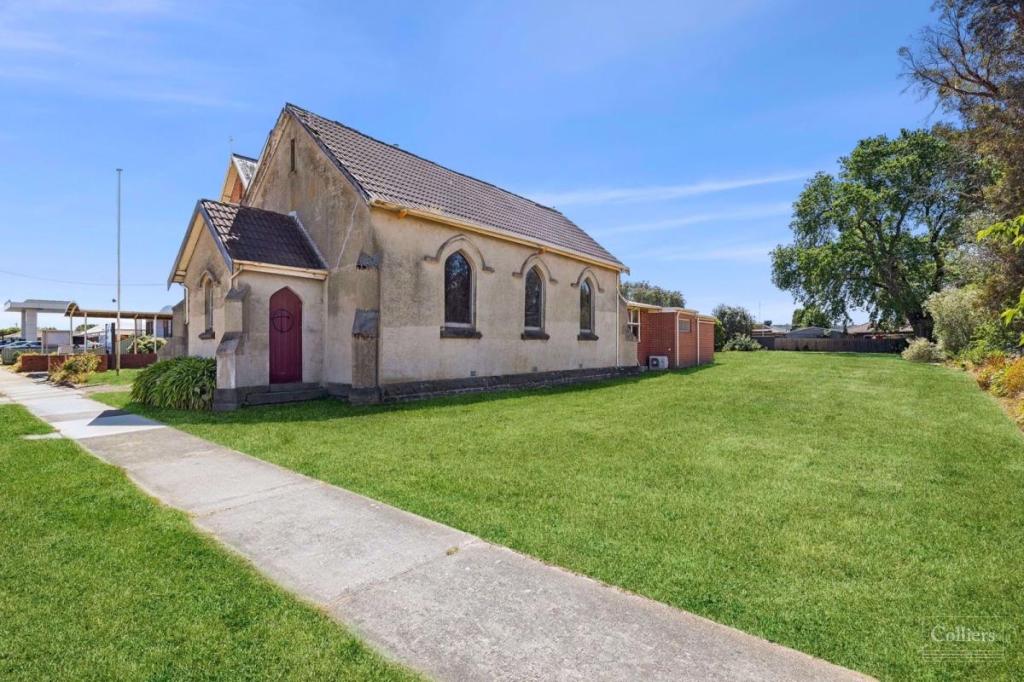
The first Holy Trinity church, built in the i850s and later used as a hall. (Photograph courtesy of Colliers International.)

The old 1850s church was soon too small for the parish and a larger church was commissioned and opened on 26 January 1868. It consists of nave, chancel and lateral vestry, built in two stages. The architect was Henry Richards Caselli (1816-1885), who emigrated to Australia from Cornwall in 1853. He worked first in Geelong and then “attracted by news of gold” (Federation University biography), “travelled to Ballarat where he witnessed the Eureka riots.” After a time prospecting he resumed work as an architect and designed many public buildings in Ballarat, including at least five churches. 

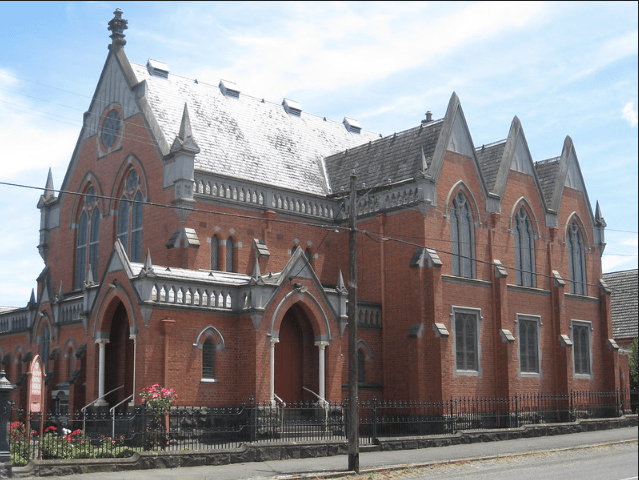
Holy Trinity is oriented east-west and has Caselli’s typical low-arched windows, an interpretation of English Perpendicular Gothic, on the front facade and along the nave. The handsome east window is English Decorated in inspiration. There is an ironwork bell-tower beside the vestry. The 1850s former church has a fireplace and chimney, often seen in the vestries of nineteenth-century churches but most unusual in a nave.
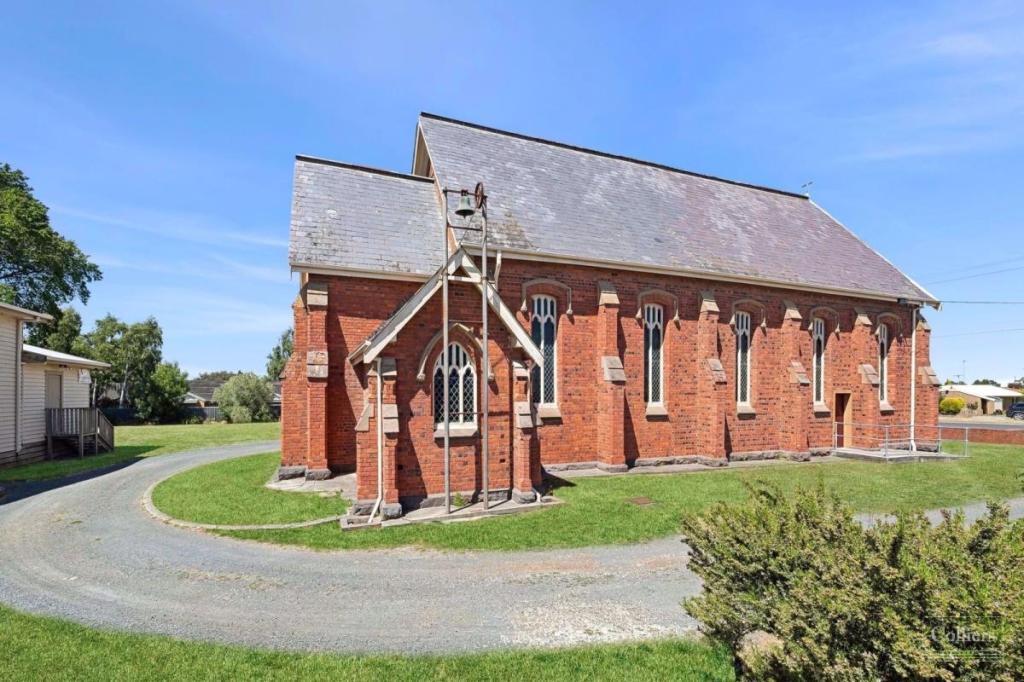
Above and below: Two views of Holy Trinity, Sebastopol, before its sale. (Photograph courtesy of Colliers International.)

The front portion of the new Holy Trinity was opened for worship by Bishop Perry (of Melbourne) on 26 January 1868, the chancel end being closed off with wood to allow for future extension. In three years this building too was too small, and it was extended to its present size and re-opened in March 1870. Since then it has remained unaltered, apart from a hideous 1960s covered walkway at the front, which perhaps the Sikhs will do away with. 

One wonders, though, why the damaged hall could not simply have been abandoned with its roof unrepaired and the church retained. 
DAYLESFORD UNITING CHURCH

CENTRAL SPRINGS ROAD, DAYLESFORD

One of the finest spires in country Victoria.

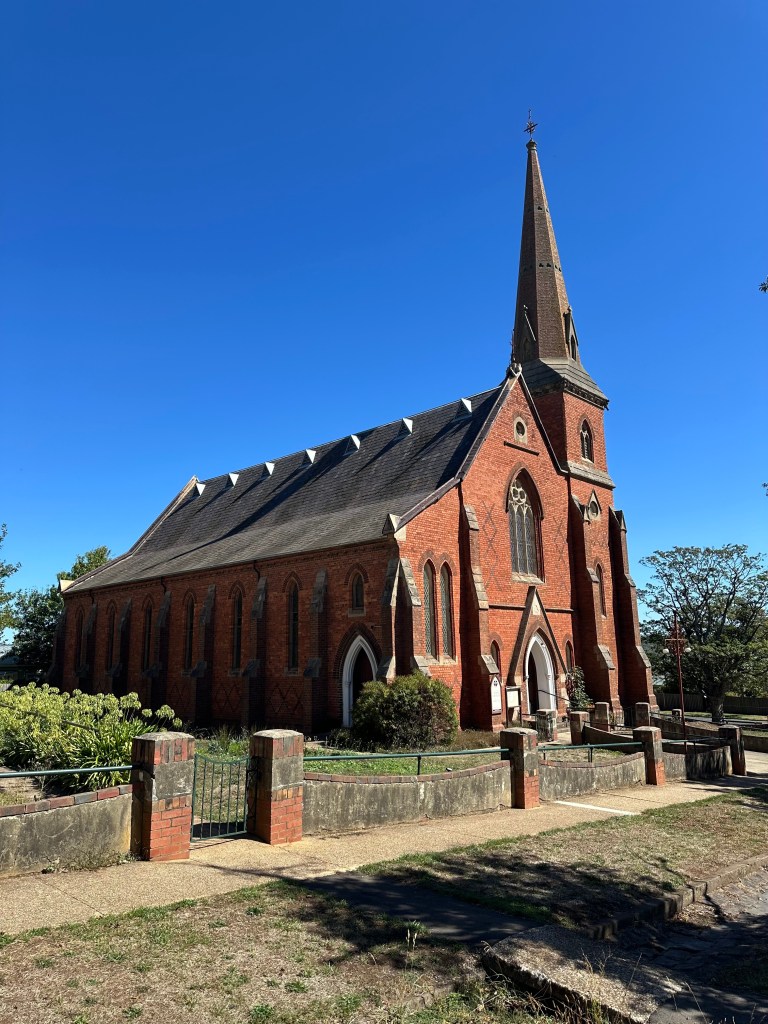
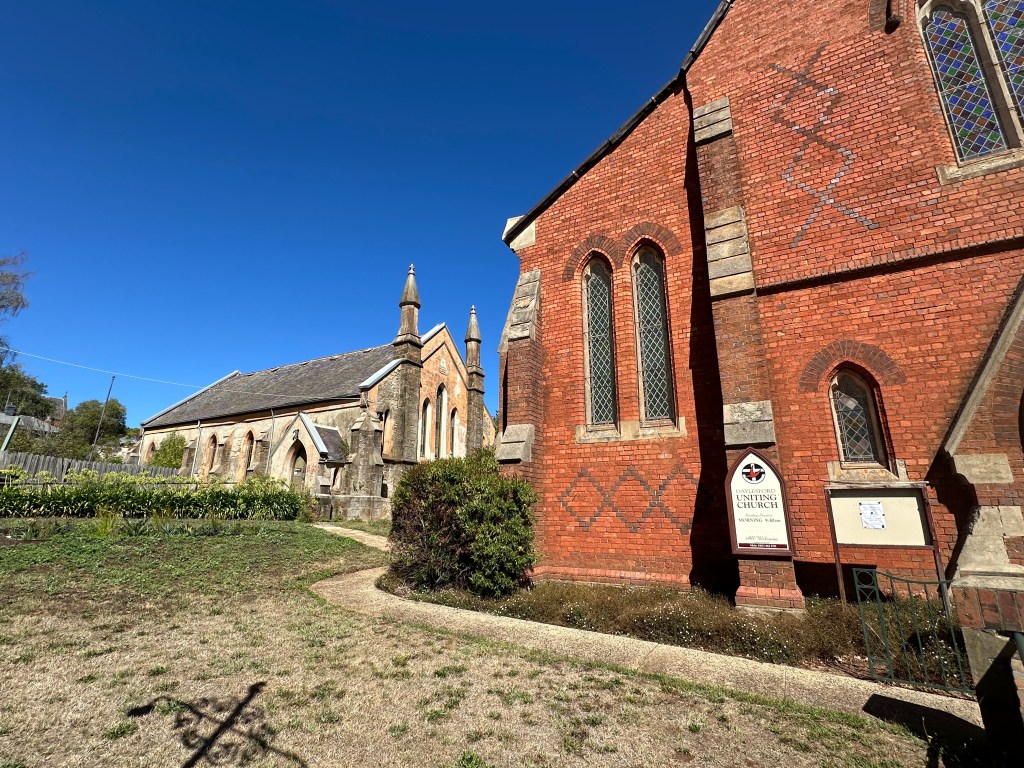
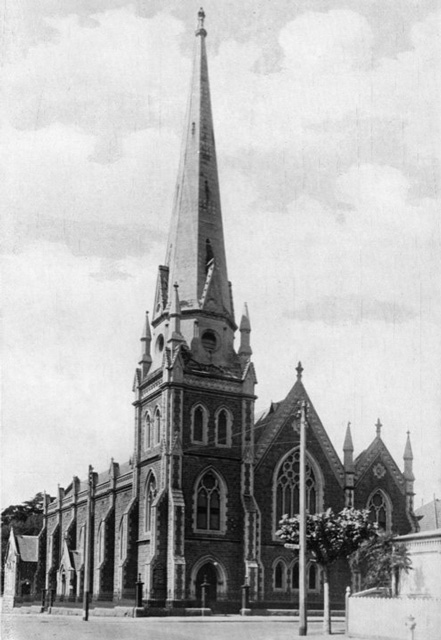
The very picture of an English country church: the Uniting church at Daylesford, Victoria, now closed and up for sale.

Above the trees that cloak the hill on which the pretty central Victorian spa town of Daylesford is built, three silhouettes stand out as you approach from the south: the spiky turret of the state school, the square Italianate tower of the post office and the brick tower and spire of the Methodist, now Uniting, church. The Anglican and Roman Catholic churches nearby have no spire or tower; only this solitary, graceful spire indicates a Christian presence in Daylesford.

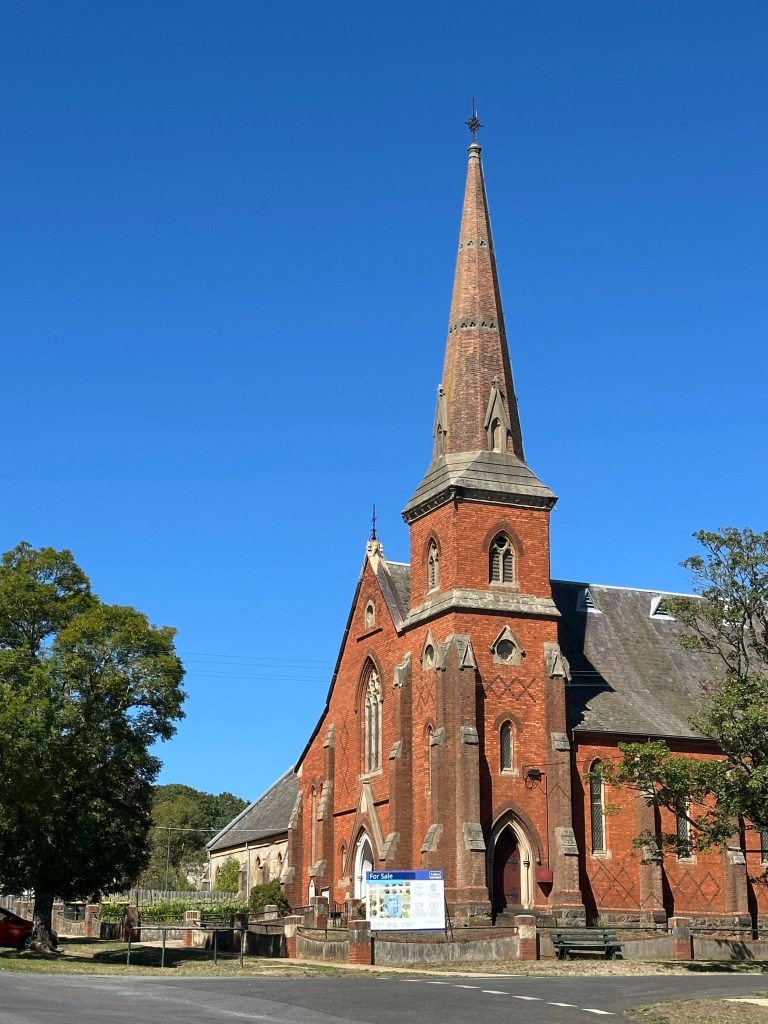
The Daylesford Uniting church looking rather forlorn with its “For Sale” board.

Soon there will be no indication at all, and this spire will designate someone’s house, or flats, or some sort of secular “space” for arts or “community use”. The ebbing tide of religion in Australia has left the church beneath the spire closed and up for sale.

Country churches are being shut down and sold all the time. Usually they are plain little buildings, perhaps of weatherboards with iron roofs, with no pretensions to architectural distinction. For the ecclesiologist, if that term isn’t too self-important, it is a pity when they go, but much sadder when an important and eye-catching church is separated from the function for which it was built (see St Kilda Presbyterian church). This proclaims to all who see it, as though in huge letters, that Christianity is in retreat, that it has shut up shop in this particular place, that its mission is abandoned.
The tower is handsomely buttressed at the corners and has a two-light pointed window at the bell stage with a broach spire.

The Daylesford Uniting congregation would perhaps dispute this, and they continue to meet elsewhere in the town. There would be less sense of melancholy if the church they have left wasn’t so obviously a church. That is the problem. Churches were once built in a particular ecclesiastical style to look like churches, and one that is secularised and “developed”, especially if it has a spire or tower or other ecclesiastical features, cannot but convey an air of departed purpose.

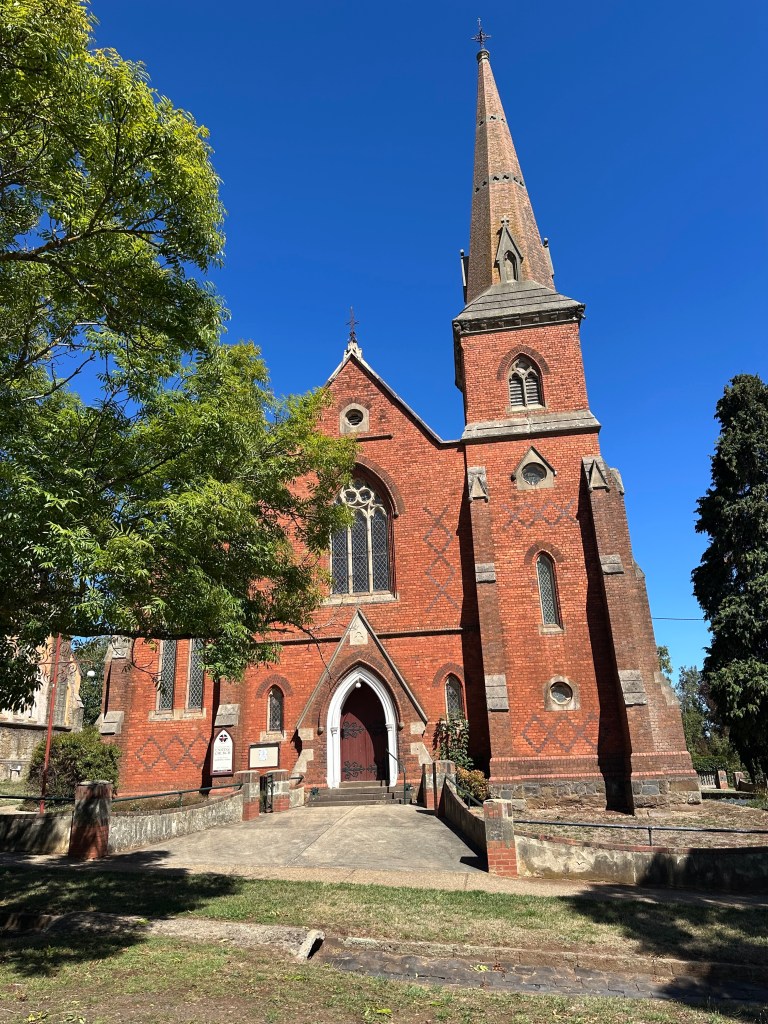
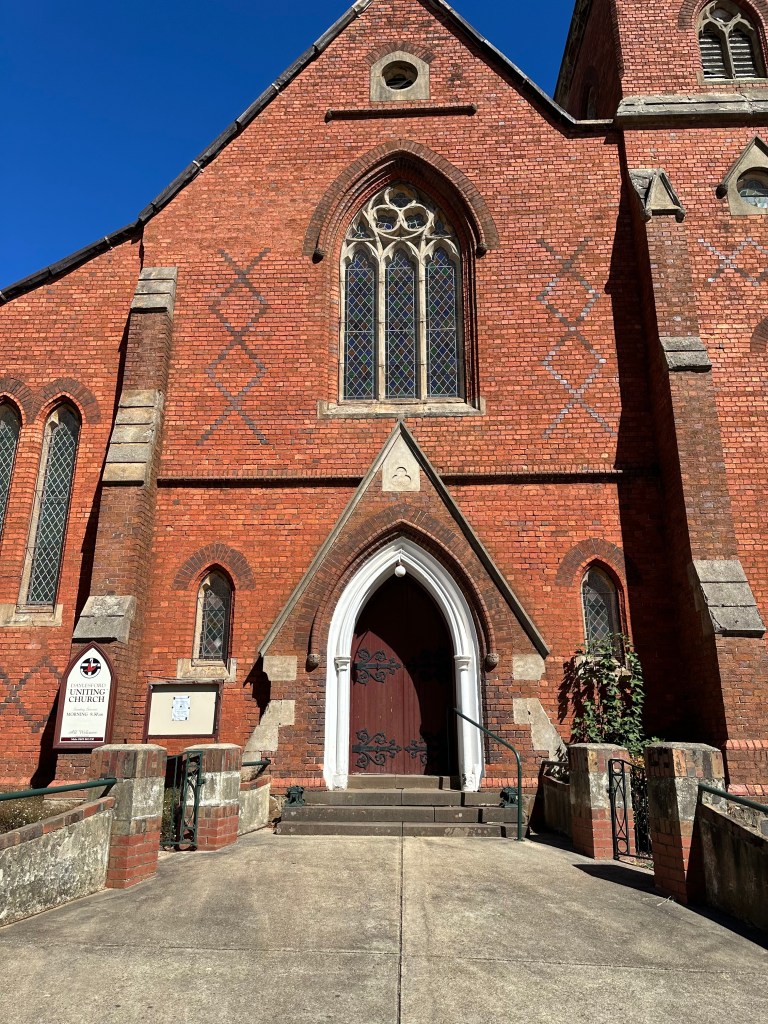
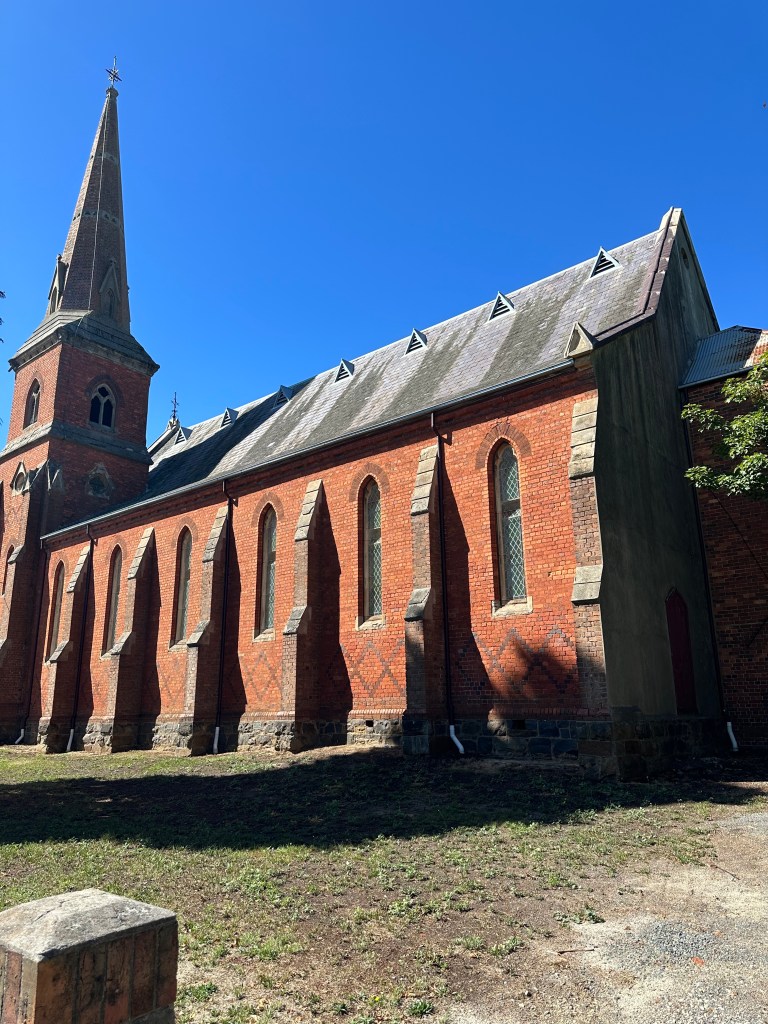
The church has diaper patterns on its brick façade.

Costs of maintenance combined with smaller numbers attending church, and those that do getting older, are generally the reasons for church closures. History and experience suggest that this decline might not go on forever, and it would be better if unused churches could be “mothballed” or let temporarily to tenants who would maintain them with as few alterations or adaptations internally as possible. This is likely to happen in only a few cases.

The Daylesford Uniting church and the sandstone chapel beside it were designed by the firm of Crouch and Wilson, architects of a number of Methodist and Presbyterian churches (and the elaborate Immaculate Conception Roman Catholic church in Hawthorn, Victoria). The chapel at Daylesford was built first, in 1861, and the church four years later. The site slopes steeply towards the west.

The sandstone chapel beside the church was built in 1861, four years before the church.  

The church is built of brick in the Early English style of Gothic, and indeed is very “English” in appearance – it could almost be a country church in a village in a British tourism photo. It consists of nave and internal side aisles without a clerestory and has an unusual diaper-patterned façade. Its chief feature is the tower and spire, a graceful and architecturally correct composition. It is almost a replica in brick of William Wardell’s larger spire at St John’s Toorak, Melbourne, and is one of the very best of its type in country Victoria.

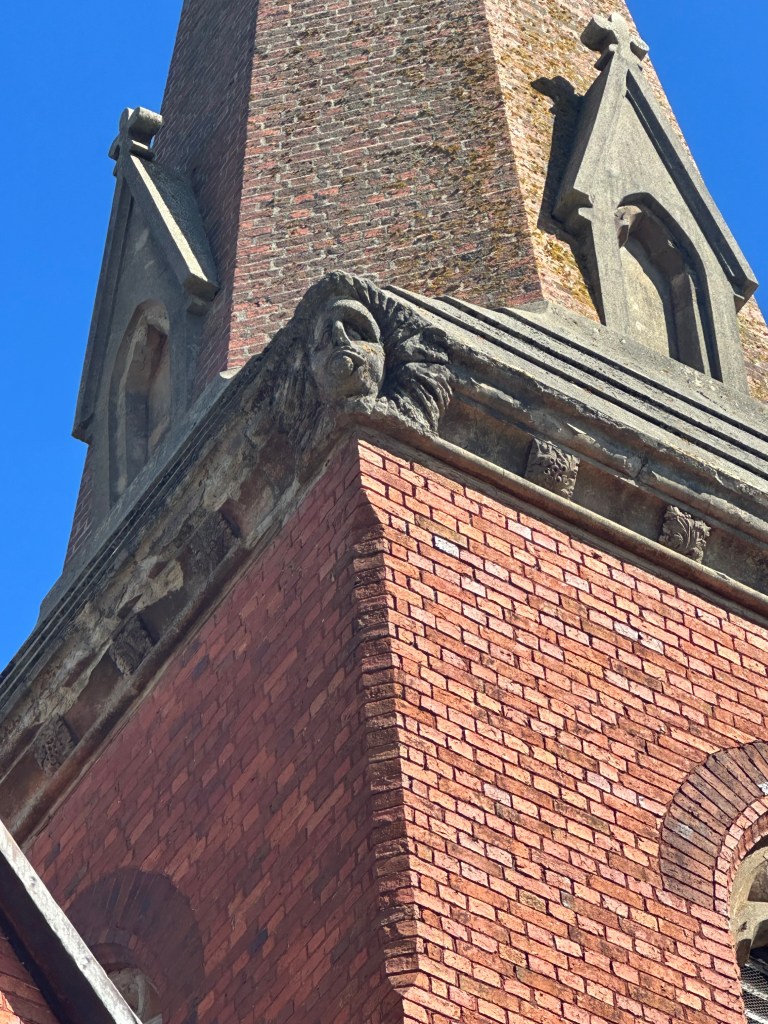
A gargoyle at the base of the spire. Carved corbels support the cornice.

The tower is handsomely buttressed at the corners and has a two-light pointed window at the bell stage. The spire is in the broach form – a spire without corner pinnacles at the base – a rarity in Victoria (there are others at Brighton and Toorak in the Melbourne suburbs, at Geelong, Hamilton and Warrnambool). Of particular note is the corbelled cornice at the foot of the spire with carved rainwater heads in the traditional form of gargoyles at the corners.

The Daylesford congregation was flourishing, with well attended services and the usual round of social activities, in the 1950s and 1960s, but like so many others has been in decline ever since as Australians lost the habit of churchgoing – and nowhere more have they lost it than at Daylesford, a growing town full of tourists and new residents, with restaurants and lavish accommodation in abundance, yet now with two empty and redundant churches.

The Daylesford Uniting church from the south, seen from lower down the sloping site. The diaper pattern continues on the side walls.

PHOTOGRAPHY FOR THIS POST BY ANTHONY BAILEY

ST CATHERINE’S, SOUTH CAULFIELD

(ANGLICAN)
KOOYONG ROAD, SOUTH CAULFIELD

Closed after a valiant attempt to keep it going.

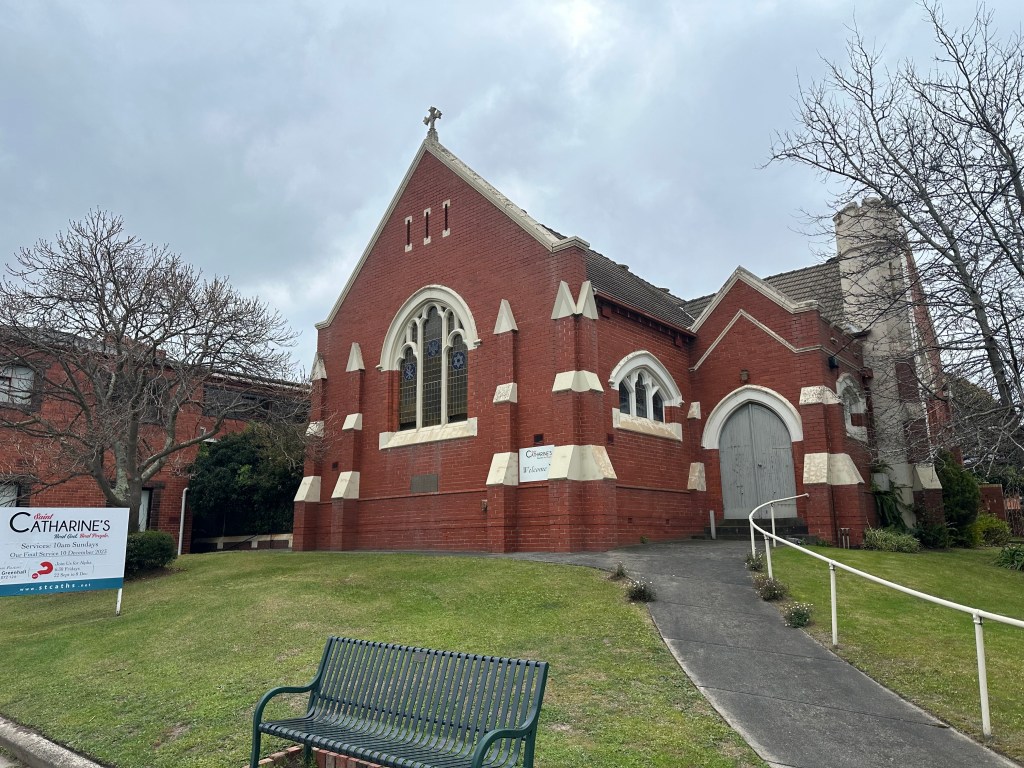
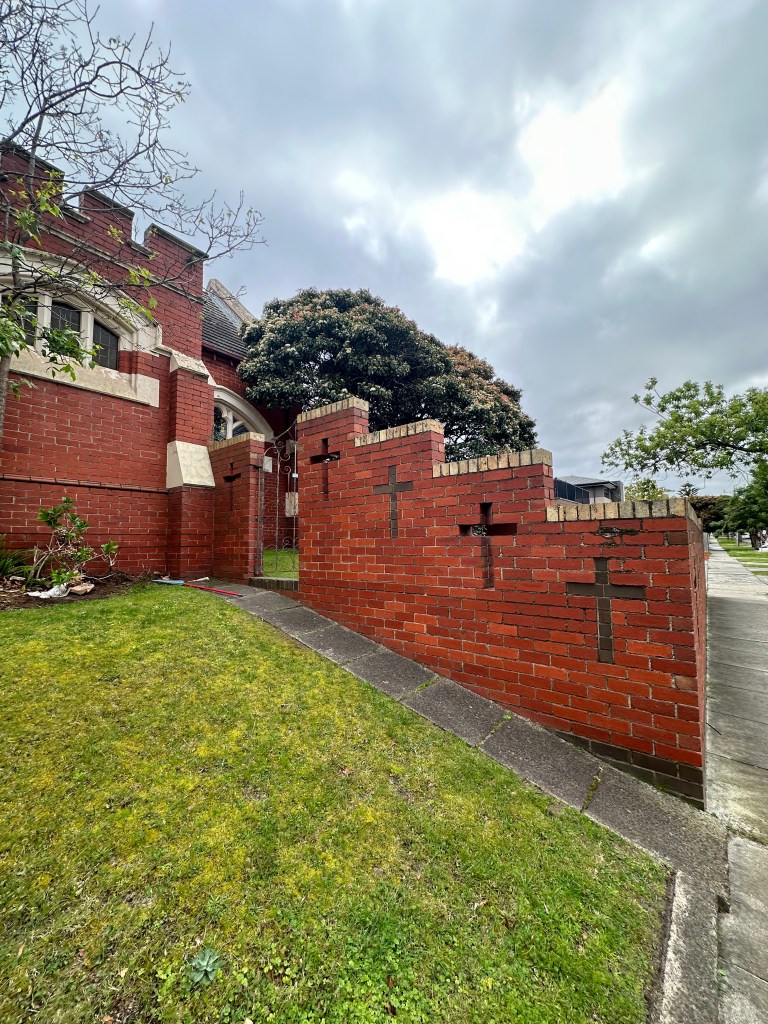
St Catherine’s, South Caulfield, on its grassy knoll. The church was built in 1921 at a time when suburban churches were flourishing. The industrial-looking parish hall is to the left of the picture.

This unassuming brick church on its grassy knoll above a street corner has finally succumbed to closure after years of hanging on by a thread. It has been shut down for the usual reason – not enough attenders – even though the Anglican diocesan authorities were only a few years ago said to be “determined to keep it going.”

It has not gone without some radical attempts to do that, culminating in various ventures in the direction of Anglican-Pentecostalist non-liturgy for the “post-churched” and other non-churchgoers. There were two services on Sunday morning, with, as an observer put it, the second intended to “look different and sound different”, an aspiration expressed “on the minister’s T-shirt with the slogan ‘Get used to different’” (surplices seem to be a thing of the past in Anglican Evangelical churches). The parish went “on a journey to curate a worship space that is inclusive; that caters for diversity; and connects into a network of artists and actors who call St Cath’s their spiritual home.” There were art supplies available in the church, and “coffee corners for those who prefer an auditory conversation”. 

Despite all this the stay-at-homes stayed at home. The congregation shrank to about fifteen on a Sunday and the parish has now been declared unviable. A deconsecration service was held in September.

There have been quite a few such closures in the Anglican diocese of Melbourne – at Armadale, Bentleigh, Coburg East, Darebin, Deepdene, East Preston, Kingsville, Malvern, Mont Albert, North Brighton, Thornbury and elsewhere – and a glance at a typical Sunday morning in most parishes suggests there will soon be more. The era of the suburban church is passing. Even so, the diocese reports that $69 million was raised from the sale of properties between 1998 and 2020, most of which went into churches in new areas and other forms of “mission “. 

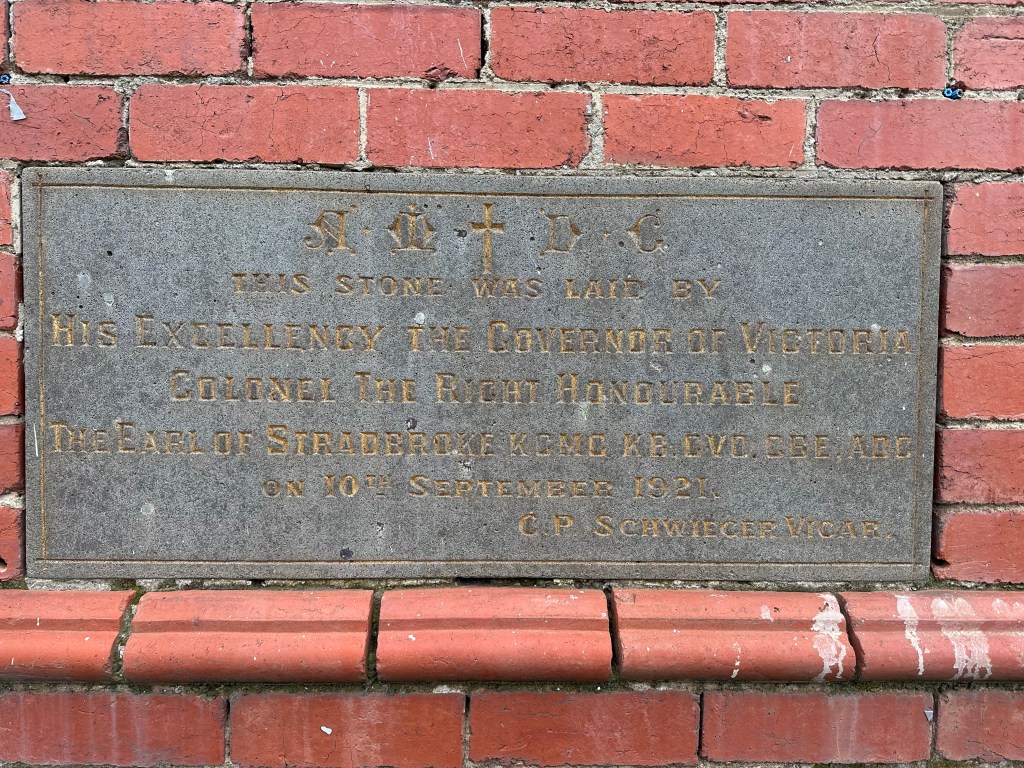
The foundation stone of St Catherine’s, laid in 1921 by the Victorian governor of the time, Lord Stradbroke.

St Catherine’s was built in 1921 at a time when suburban churches were flourishing. It replaced at least two earlier and smaller churches on other sites and was considered important enough for the Governor of Victoria, the Earl of Stradbroke, to lay the foundation stone. 

The architect was Daniel Dossetor (see addendum), and the building has similarities, particularly in the crenellated turret between the porch and south transept, to Christ Church, Essendon, designed by him and built about the same time as St Catherine’s. The turret stands in for a bell tower.

A. memorial garden in the angle of transept and chancel.

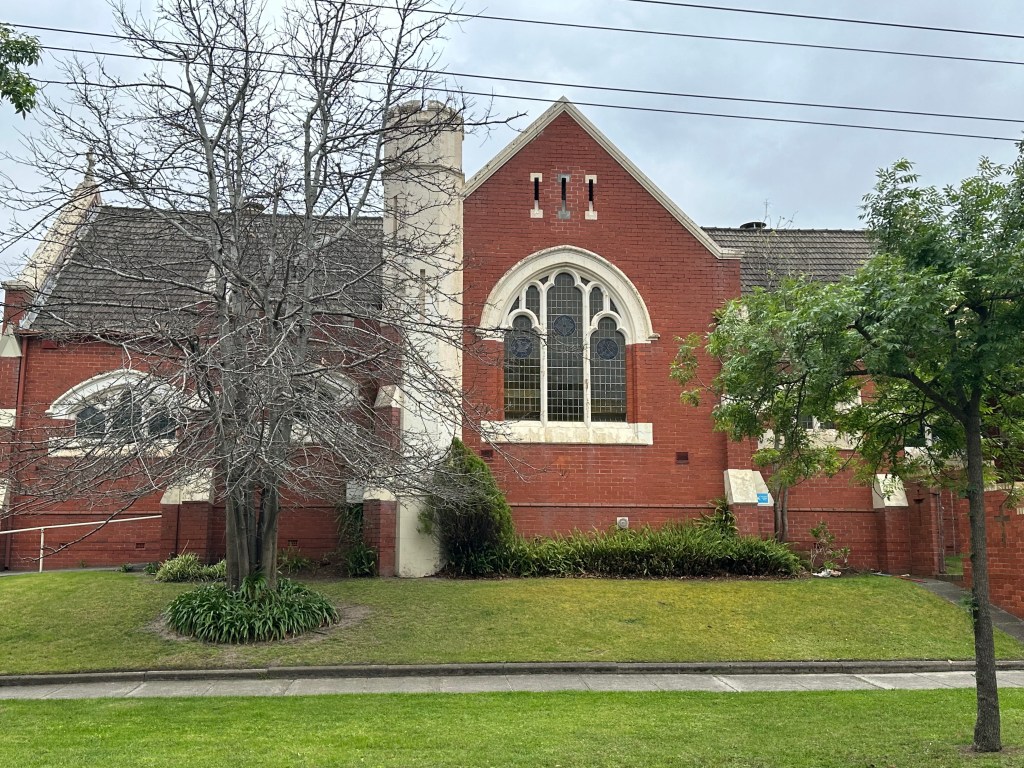
The church is built of red brick with cement dressings. It is unusual among Anglican churches in Melbourne in having a rather Methodist look. But the cruciform plan is conventional Anglican, with nave, short transepts and chancel with vestry and organ chamber. Inside, the walls are plastered and plain and there is a timber barrel roof. There were choir stalls in the chancel, but these have been removed in a general rearrangement of furniture for less formal, “different”, worship. 

There is little external ornament, although the windows, of Gothic inspiration but shallower than traditional Gothic, are well proportioned in relation to the walls in which they are set and give a certain sense of noble simplicity. 

There is an especially ugly parish hall reminiscent of a small factory on the Kooyong Road frontage. The whole block will probably sell quite well for redevelopment, though demolition of the church (but not the hall) would be a pity as it is about the only building with any character anywhere nearby.

St Catherine’s from the south showing the crenellated turret . The church is orientated east to west in correct liturgical tradition.

PHOTOGRAPHY FOR THIS POST BY ANTHONY BAILEY

UPDATE 6.11.2024: John Richard Maidment writes: Daniel Dossetor was surely the architect.  The Revd C.R. Schwieger had previously been at Christ Church, Essendon where a cheaper church was built to Dossetor’s designs after North & Williams’s earlier design was rejected probably on the score of cost. He moved to Caulfield. The only other church design by Dossetor that I know of was the second Australian Church, in Russell Street, which had an industrial appearance at least externally – maybe he also designed the hall at St Catharine’s built after 1939. North & Williams did the vicarage at St Catherine’s dating from 1916, so before the current church was envisaged.
Dossetor was based in Essendon as I recall and did a homestead north of Tullamarine airport.

UPDATE 18.11.2024: St Catherine’s is closed and was deconsecrated in September. It appears still to be in use as a “memorial venue”, i.e. undertaker’s chapel. This is as good a result as could be hoped in the circumstances. At least it means the building will not be radically altered or demolished, for now.


PRESBYTERIAN CHURCH, ST KILDA

(CORNER BARKLY STREET AND ALMA ROAD, ST KILDA)

For sale after 170 years.

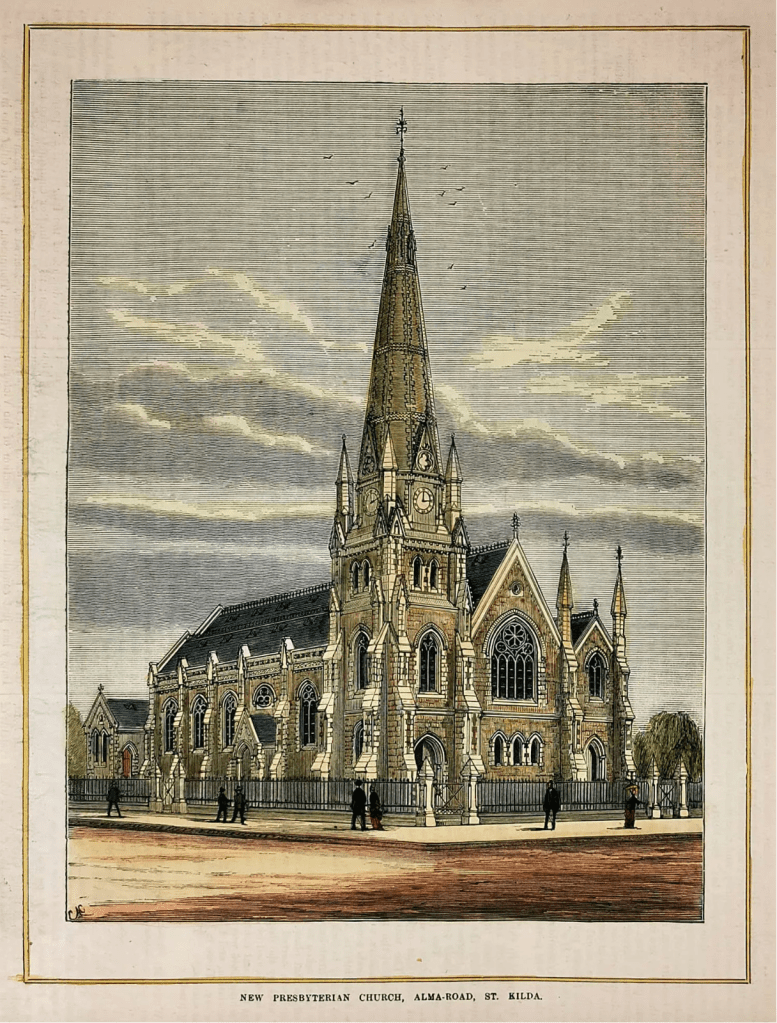
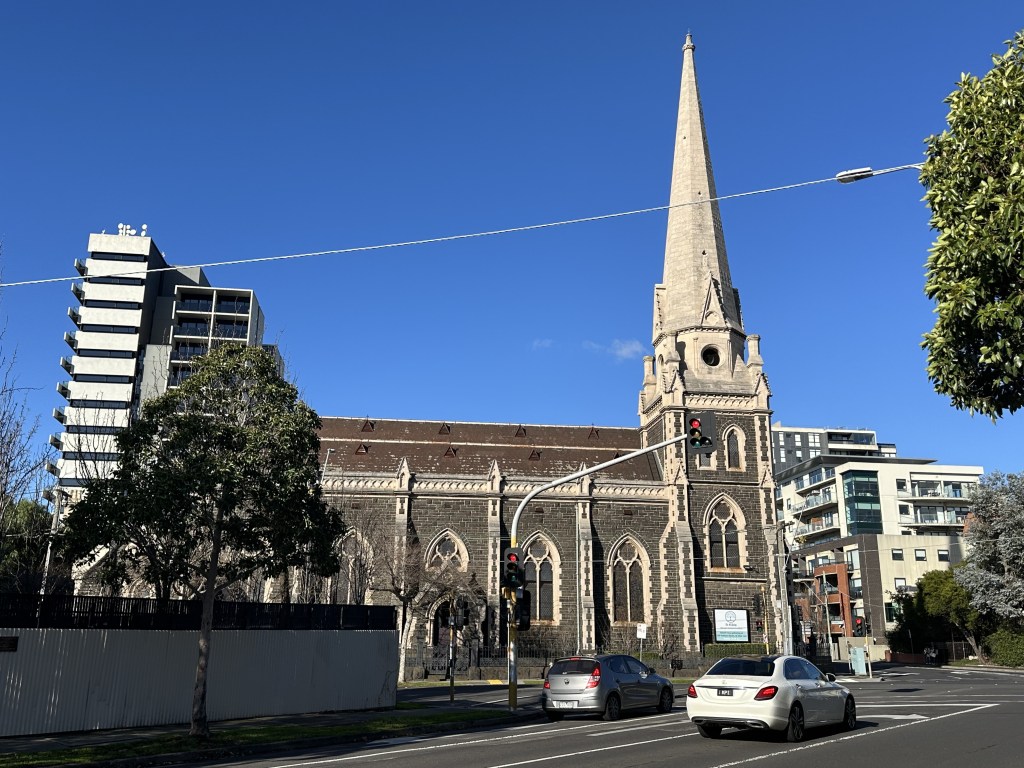
The “new” St Kilda Presbyterian church in a postcard published soon after its opening in 1886. http://handle.slv.vic.gov.au/10381/257739

It looks as though redundancy might finally have caught up with St Kilda’s splendid Presbyterian church, a church already once snatched from the jaws of closure.

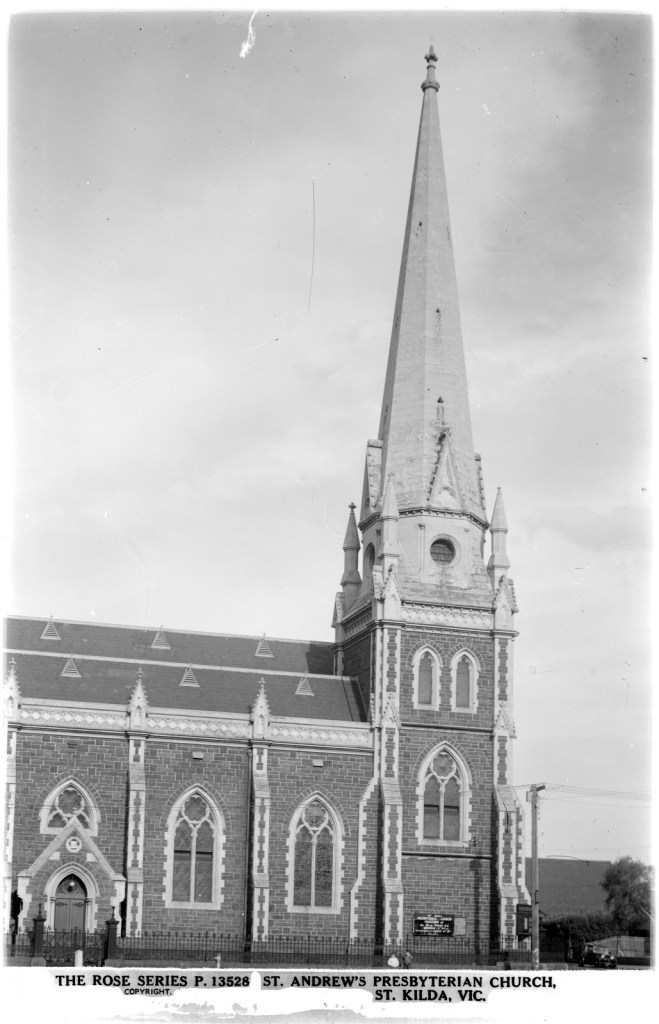
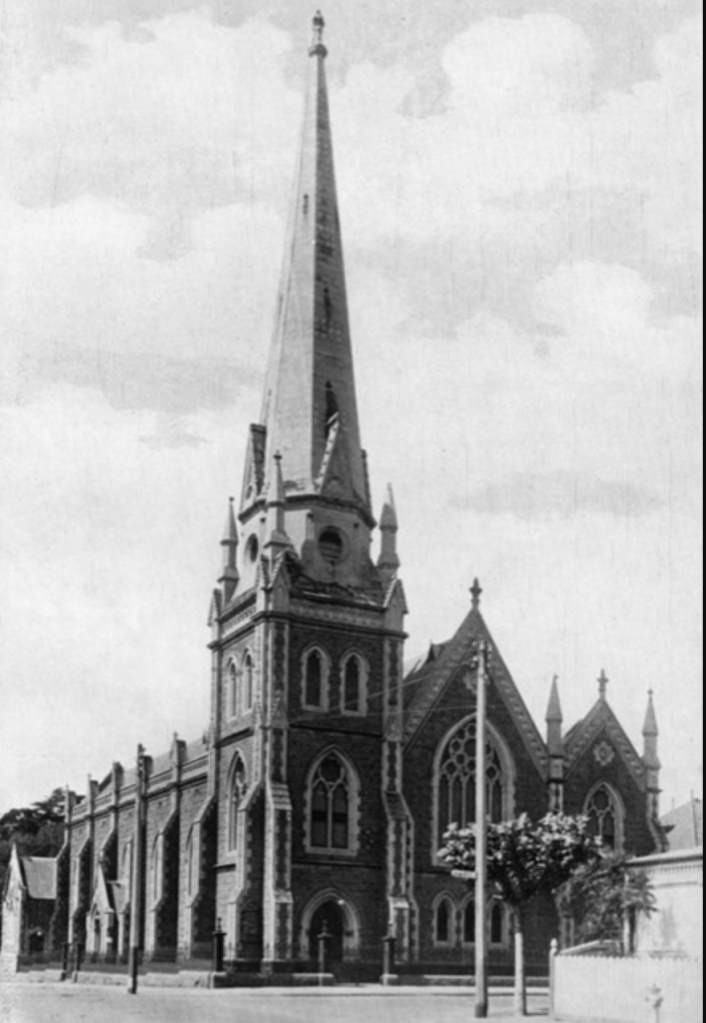
With its soaring 142-foot spire a landmark visible from all over the district, this church is the most prominent building in St Kilda, just about holding its own against the challenge of several recent tower blocks of flats. From out to sea the profiles of the spire and the similarly impressive campanile of the Sacred Heart church in Grey Street give the St Kilda skyline its distinctive character. (The Anglican church, Christ Church, was to have had a spire too but never got one, and with a congregation of 30 is unlikely to get one now.)

Side view of the St Kilda Presbyterian church in the 1940s. The card is captioned “St Andrew’s”, though this dedication seems not to appear elsewhere. Note the empty apertures where a clock was intended. The conical caps on the tower pinnacles have since been removed. http://handle.slv.vic.gov.au/10381/58744
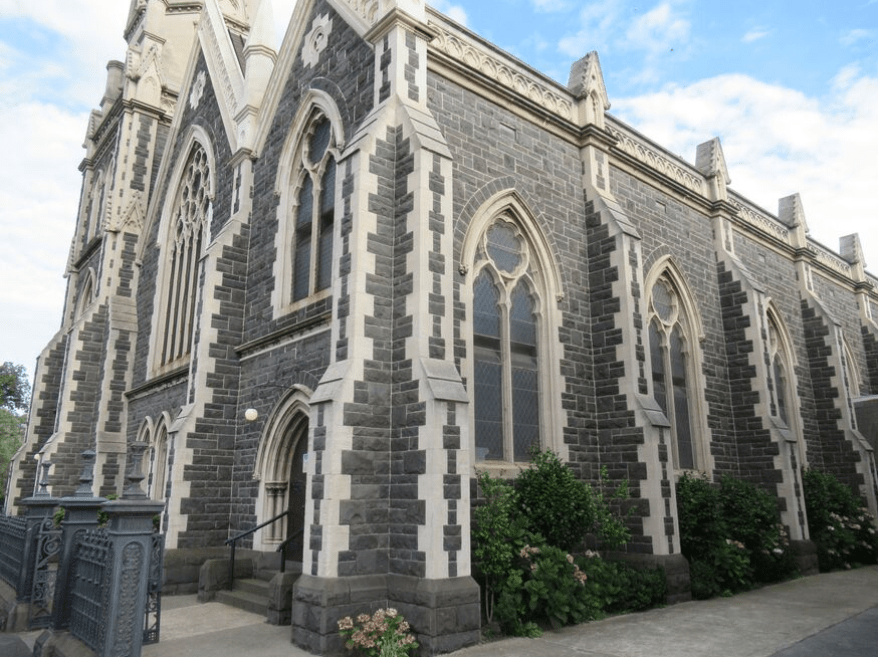
The St Kilda Presbyterian church was built in 1885-1886 of bluestone with freestone dressings. The architects were the partnership of Wilson and Beswicke, formerly Crouch and Wilson. The style was a version of English Decorated Gothic and the size of the building testament to the numbers and wealth of Presbyterians in St Kilda at the time. The exterior is dominated by the tower and spire, imaginatively placed right on the hill crest above the intersection of three busy streets. The tower has corner pinnacles (now missing their conical caps) and circular clock openings placed beneath Gothic gables but without any sign of a clock – was there ever one? 

Façade and east side of the St Kilda Presbyterian church.

The building is unusual in Australia for being a “hall church”, that is, a church with a nave and aisles of about the same height, separated by arcades but without clerestory. Two of the relatively few other examples are actually close by – All Saints’ in East St Kilda and Christ Church, South Yarra. The nave terminates in an apse with communion table and elders’ stalls.

At some point the church was known as St Andrew’s – St Andrew is the patron saint of Scotland and many Presbyterian churches carry that dedication – but has for years been known by its locality.

The following description of the interior of the church by John Maidment in the Organ Historical Society of Australia’s Gazetteer cannot be bettered.

The spacious hall-church interior, with lofty aisles, broad nave and raked floor, focusses upon a large apse whose ceiling (like The Scots’ Church in the city of Melbourne) was once embellished with stars. At the rear there are twin porches and a narthex with a staircase to the rear gallery where the choir and an earlier organ were initially housed.  The aisles are divided from the nave by tall cast iron columns with floriated capitals; this material is also used for the balustrading of the gallery and pulpit as well as the external fence and gates.

The building is lit by large Gothic windows with geometric tracery.  They incorporate glass by the following craftsmen:  in the apse, Ferguson & Urie, depicting Faith, Hope and Charity; on the west side, at the rear, Ernest R. Suffling, Edgware Road, London (signed) c.1892; and two windows to the front, the first by Mathieson & Gibson, of Melbourne (signed) inserted in the 1930s and a second, to the left, probably by Brooks, Robinson, inserted in 1949. To the east there is a splendid window by the renowned artist Napier Waller, dating from 1950, of interest for its stylised faces and leaf patterns.  The remaining windows have quarry glass with coloured borders.

The woodwork in the church is of particular note. The magnificent pulpit, in polished kauri with blackwood detailing, incorporates intricate relief panels, splendidly carved by John Kendrick Blogg, depicting the burning bush, wheat ears, grapes and St John’s lilies.  In the narthex there is a First World War memorial finely carved in Tasmanian blackwood. The cedar pews incorporate ends of unusual design with turned columns and enamelled location plaques; the central section is divided. The ceiling is of tongue and groove boards laid diagonally.

The effect in the days when the church was full every Sunday must have been striking.

The threat of closure has hung over the St Kilda Presbyterian church for quite a while. For some time in the 1990s it actually was closed, until reopened by a small returning congregation. Soon after that, its Gothic stonework, particularly on the high gable ends that are most exposed to St Kilda’s maritime weather, was found to be deteriorating to the point of being unsafe. The worst damage was restored and paid for by insurance.

St Kilda Presbyterian church photographed for the St Kilda Historical Society. https://stkildahistory.org.au/images/Churches/St_Andrews/View_ca1930-c.jpg

Around about the same time the elaborate painted decoration of the interior was restored. The result was one of the most impressive Gothic structures in Melbourne – not exactly beautiful, its architectural detail not being fine enough for that, but imposing.

With the building in reasonable condition again, there seemed no reason why the church’s small congregation could not continue to worship there for the foreseeable future. The difficulty has arisen because of the cost of maintenance, the need for further expensive repairs and the increased cost of insurance. It was therefore decided to merge the congregation with that of the Presbyterian church in East St Kilda, a rather good example of the “contemporary” church architecture of the 1950s (and built at a very late date for a new church in a very unPresbyterian suburb).

With its congregation now worshipping elsewhere, the future of the big church on the hill is undecided. Can it be reopened? Or will it have to be sold?

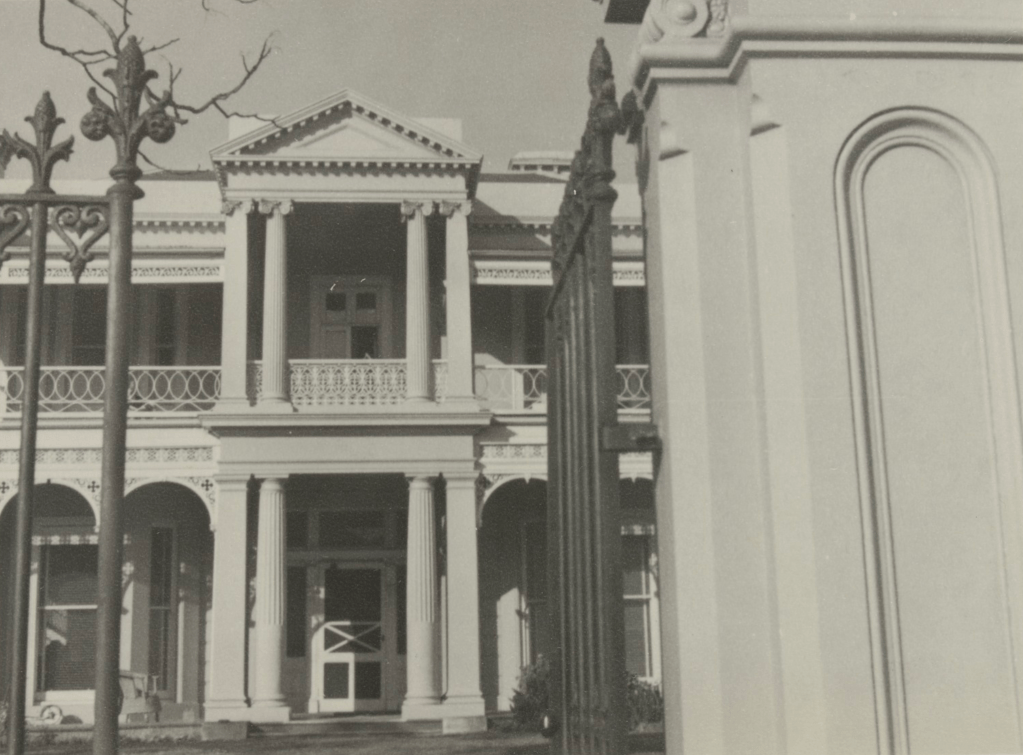
An early photograph of the former manse behind the church. Its grandeur reflects the status of the church’s Minister in the community. http://handle.slv.vic.gov.au/10381/72585

If the latter is the only alternative, it is reassuring that the minister and congregation say they would prefer that the building be taken over by another religious body, perhaps one of the “ethnic” churches that flourish in various parts of Melbourne. Conversion to a concert hall or “arts hub” (like the Neil Street Uniting church in Ballarat) would be a possibility although there is little space around it for car parking. The worst outcome would be conversion into apartments, with its fine interior carved up and partitioned and dormers and other excrescences on the roof, a fate which several important churches in Melbourne have not been spared, most notably the fire-gutted, also formerly Presbyterian, Cairns Memorial church in East Melbourne.

UPDATE 3.12.2024: Yes, the St Kilda Presbyterian church is to be sold. The boards have gone up, describing the church in the usual estate agents’ jargon as “unique” and ‘iconic” and spruiking its “endless possibilities” for conversion to luxury apartments, etc. What an indignity, not to mention architectural loss. At a price of three million dollars, no other congregation could afford this building, even if one could be found.

UPDATE 26.5.2025: The church has been sold, presumably to property developers, and is now undergoing a “heritage” assessment with a view to being converted to – what else?– apartments. No matter how sensitively the conversion is carried out, the fine interior will be lost, and heaven knows what will happen to the artistically important stained glass.

With the closure of the Alma Road church, only two churches are left in this western part of St Kilda, the Roman Catholic in Grey Street and the Anglican in Acland Street, both, particularly the Anglican, hanging by a thread. The Catholic has lost its independent parish and the Anglican has a very low attendance. If you’ever wondered what the post-Christian world will look like, come and see it in St Kilda.

NEIL STREET UNITING CHURCH BALLARAT

(FORMERLY METHODIST)
CORNER OF NEIL AND MACARTHUR STREETS, BALLARAT

Yet another “arts centre”.

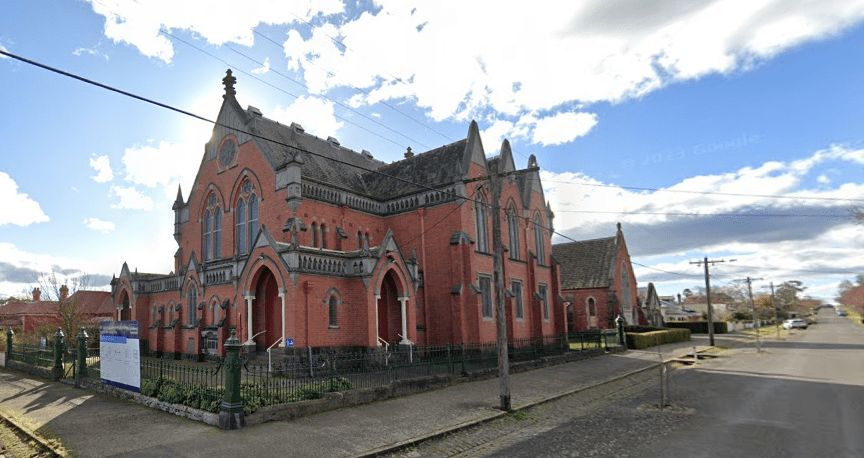
An imposing presence in a dull streetscape: the Neil Street Uniting church, Ballarat.

One by one, they shut down, the Uniting churches of Ballarat. The most prominent, St Andrew’s, and the Pleasant Street church have already long since passed into secular use (see separate posts). Soon the only church left in the city centre will be Wesley Church in Lydiard Street. The latest to go is this grandiose edifice on a prominent corner in Neil Street. Too cavernous for a reduced modern congregation, it held its final service on 5 February 2023 and a year later was put up for sale as a “development site”.

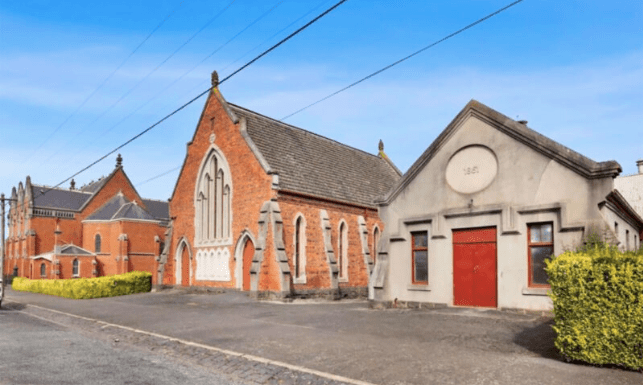
The church is the third on the site – the earlier two, one brick, one timber, are behind it and used as halls. It was built for Ballarat’s then flourishing Methodist community. Methodists were numerous in Ballarat as a consequence of the gold rush (gold was found at Ballarat in 1851) when many Cornish miners and their families arrived to try their luck on the diggings and settled in the district. The historian Geoffrey Blainey records in his memoirs that when his father went to Ballarat as a minister in 1941, the Methodists had more churches – eleven – than the Anglicans and Roman Catholics put together. That remained the case until 1977, when Methodist congregations in Ballarat were subsumed into the new Uniting Church, which has since proceeded to sell off many of the former Methodist buildings, the latest being that in Neil Street.

The second (left) and first churches on the Neil Street site. Both are now used as halls. Picture: https://bpacballarat.org/

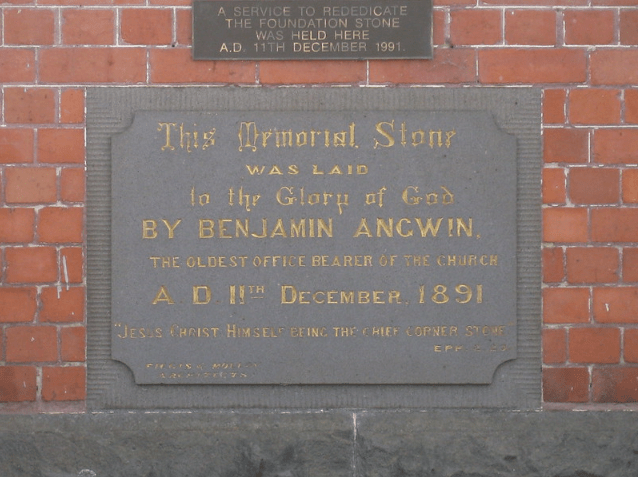
The foundation stone was laid in December 1891 and the church opened ten months later. The architects were Figgis & Molloy, who also designed the nearby Scots’ Presbyterian church (see post).

The stone laid by the church’s oldest office-bearer at the time, on 11 December 1891.

Resting solidly on foundations of bluestone and concrete, the Neil Street church is built of brick, with dressings of stucco and roofed in slate, in a conventional Protestant arrangement of the era, that is, Gothic details and ornament applied to an unGothic auditorium.

The highly symmetrical façade of the Neil Street Uniting church, “liberally pinnacled”.
Picture: https://victas.uca.org.au/church/ballarat-neil-street

The imposing lofty façade has corner pinnacles on corbelled shafts and, uppermost in the gable, a genuine “wheel window” with radiating tracery. Its principal feature is two tall double-light windows with plate tracery. Below these a projecting enclosed narthex, also liberally pinnacled, runs the width of the church. with gabled porches at either end.

The sides of the building – and here we really depart from Gothic convention – consist of two bays of nave and three abutting gabled transepts, making a five-bay elevation in all. The transepts are  open to the nave internally., separated only by slender iron columns, also quite unGothic, reminiscent of the kind you see on a nineteenth-century shop veranda or railway platform canopy. The combined interior space of nave and transepts forms a capacious auditorium, rectangular in plan. At the north (liturgical east) the nave ends in a shallow apsidal chancel that, in line with Methodist tradition, contains the choir and pulpit. A rectangular chamber behind the choir houses the organ.  

The transepts have two rows of windows, which suggests the existence of galleries, now removed. It is clear that this church was built to house a very large congregation.

Unlike so many churches that close, this one may yet be saved from radical “redevelopment”. The building was first put up for sale for its site value, but the Uniting Church has agreed that if a local arts association, which for several years had held rehearsals and concerts in the church, can raise the purchase price, they will be able to acquire it as a “performing arts venue and hub”. Though the best outcome for threatened churches is that they remain churches, use as an arts venue will at least preserve the building and its interior reasonably intact and save it from demolition.

Some of the information in this post is taken from the entry on the Neil Street church in the Organ Historical Trust of Australia’s gazetteer.  

The Neil Street church with its unusual three-transept arrangement, though they are only transepts externally with no internal walls.

ALL SAINTS’ OLD CATHEDRAL, BENDIGO

(ANGLICAN)
MACKENZIE STREET, BENDIGO

Derelict after a century and a half.

All Saints’ Old Cathedral, Bendigo. The 1935 additions are on the right.

This unassuming Gothic Revival church in the Early English style on a hill in the heart of Bendigo long did service as a cathedral. It is now derelict and much desecrated by vandals, who invariably, such is the respect for the past (and other people’s property) in our society, lie in wait to pounce on any building as soon as it is left empty. 

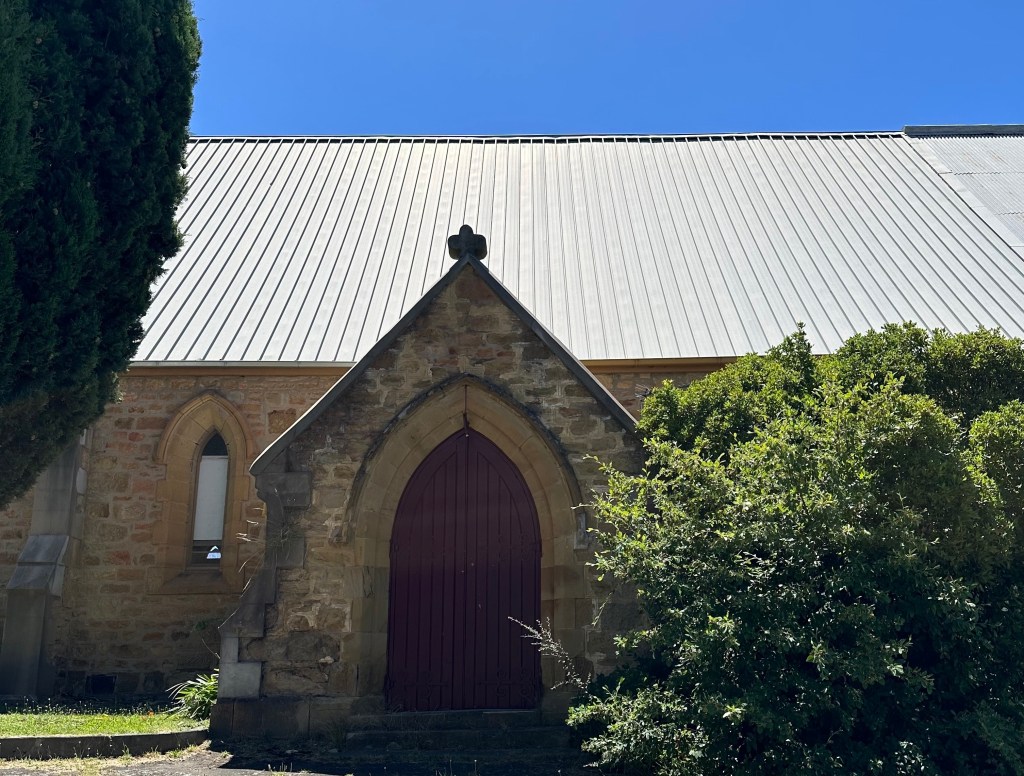
The church consists of a nave and porches built of freestone, not the most durable building stone but the best that could be obtained with the funds then available. A chancel and vestries were added later. 

A postcard of All Saints’, Bendigo, when it was still the pro-cathedral.

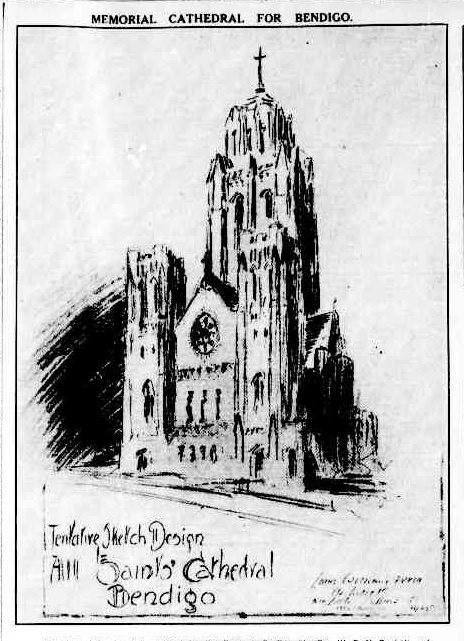
The nave was opened for worship in June 1856. All Saints’ remained a parish church until 1902 when the diocese of Bendigo was established and All Saints’ became its pro-cathedral. The new diocese had greater aspirations for its permanent cathedral than this simple building and intended eventually to replace it. Various proposals were made at successive annual synods until in 1925 the prolific church architect Louis Williams was commissioned to design a new cathedral on the site. Williams’s drawings, prepared in association with the firm of Gawler & Drummond, show a soaring cathedral in his characteristic and attractive personal version of Neo-Gothic, with nave, transepts and chancel, twin towers on the façade and a much taller tower over the crossing, capped with a square lantern. This building would have seated 1000 people.

Architect’s “tentative sketch design” of All Saints’ Memorial Cathedral as it would have been, shown in the Melbourne Argus of 29 June 1925. High on a hill in central Bendigo with its central tower overlooking the city, the cathedral would have seated a congregation of 1000. https://trove.nla.gov.au/newspaper/article/2131517

A certain amount of euphoria greeted the publication of these plans. The Bishop of Bendigo, the Right Rev. Donald Baker, waxed lyrical in a letter to the editor of the Melbourne Argus appealing to past Bendigo residents for funds to start building:

Sir.-The splendid design of the proposed new Anglican cathedral for Bendigo … will, no doubt, thrill all old Bendlgonians who can visualise the magnificent site of All Saints’ hill from which it will dominate the whole of the city, and its environs.

Its “domination” of the city would in time have been shared with the even more imposing Sacred Heart Roman Catholic cathedral on the same hill. The profile of these two great buildings would have made the Bendigo skyline among the most impressive in Australia. It was not to be, and only the R.C. cathedral was built.

The east end of All Saints’ Old Cathedral, Bendigo.

The appeal for the Anglican cathedral was not wholly unsuccessful, but didn’t raise enough to embark on the entire project. Only chancel and vestries were built as an extension to the nave of All Saints’. The foundation stone of the additions was laid on 7 December 1935 by the Governor of Victoria, Lord Huntingfield.

Porch and nave of the original section of All Saints’ Old Cathedral date from 1856.

Embellished with some fine fittings and furnishings, among them a pulpit donated by Westminster Abbey of grained Purbeck marble, with figures of the apostles, presented to Bishop Baker in 1936, All Saint’s remained the pro-cathedral of the diocese until 1981 when a larger central Bendigo church, St Paul’s, its lofty brick tower a city landmark, was designated the cathedral in its place.   After that, All Saints’ quietly declined until it was closed in 1989. It had a brief lease of renewed life between 1991 and 2015 with a revivalist group, the View Hill Fellowship, but was sold in 2016 – 160 years after its opening. There are plans to make it the centrepiece of a housing development, which of course will effectively erase its ecclesiastical character. Many of its furnishings, including the Westminster pulpit and screens and stalls designed by Louis Williams, were transferred to St Matthew’s, Albury, when that church was rebuilt after being gutted by fire in 1991.

The abandoned Old Cathedral on its hilltop site is derelict and vandalised.

PHOTOGRAPHY BY ANTHONY BAILEY

CASTLEMAINE PRESBYTERIAN CHURCH

(CONGREGATIONALIST, THEN PRESBYTERIAN, NOW COPTIC ORTHODOX)
Lyttelton Street, Castlemaine

Pinnacled and picturesque in its place on a hill.

Exuberant is one word to describe the architecture of the Castlemaine Presbyterian church, the first of the big four churches in the centre of this handsome Victorian town to fall out of use. Its four-pinnacled profile rises high on a hill, where its gables and assemblage of lancet and rose windows, and its sprightly porches on either side – all cheerfully “incorrect” by the canons of Gothic design – give it the air of a set for Lohengrin, an effect reinforced by the theatrical patterns in coloured glass in the windows.

The church was built not for the Presbyterians but for the Congregationalists, a denomination subsumed into the Uniting Church in 1977. This amalgamation was not entirely harmonious. Not all Presbyterians agreed to the merger, and when their church, across the street from the present one, was appropriated to the use of the new Uniting Church, the “continuing Presbyterians” moved into the former Congregationalist church. There they stayed until 2021, when, for the usual reasons of age and decline, the building became too much of a burden for its congregation to maintain and was put on the market. It was sold for $2.37 million to a property company named Heavenly Trio – why do developers and estate agents persist with these toe-curling puns when selling up churches? – the trio being the church, its manse and the original Congregationalist church next door, a simple Georgian building of 1855.

All three buildings are “heritage-listed”, not that that will do them much good when the conversion to other uses gets under way. According to the new owners the “other uses” permitted by “heritage” and council laws include “conversion to residential, short-stay accommodation, childcare, commercial, a community centre or a place of assembly” (whatever that is). In other words, there’s almost nothing the church can’t be turned into, and this illustrates the fundamental difficulty of converting churches into something else. Whatever their new purpose they continue to look like churches, as do town halls, post offices, railway stations etc. adapted to other uses, so that the building never looks right for its revised secular function. (Some characterless “contemporary” churches might be an exception to this.)

The other difficulty is that unless the church is adapted with a minimum of alteration as, say, a public hall, its ecclesiastical interior will be, not to put too fine a point on it, wrecked. It will be carved up with partitions, false ceilings and mezzanines, obliterating its original identity. This rather defeats the purpose of giving the church “heritage listing” in the first place, if only the outside is to be preserved. The listing would seem to be more for the benefit of the building’s place in the “streetscape” than for the building itself.

Churches are always best preserved as churches, and now that most Australians have given up going to church that has usually meant finding an Orthodox or Coptic* or other “ethnic” congregation without a church of its own. But most of those are already provided for. Yet very few churches have become mosques for what current levels of migration must be making the fastest growing religion in Australia. Perhaps Islamics don’t want their places of worship to look like churches.   

The Castlemaine Presbyterian church was built in 1861-62 to a design by William Spencer (or Spenser), about whom little is known. It is a “hall church”, that it, with a central nave and side aisles divided from it by columns but no clerestory above. The building material is red brick. Compared with the flamboyance of the façade the sides and back of the church are subdued.

The remaining Presbyterians have moved to a school chapel on the outskirts of the town. The fate of their unusual church is yet to be determined by Heavenly Trio.

UPDATE 5.12.2033.

  • This church has been leased by the Coptic Orthodox diocese of Melbourne for use by a new parish. It is thus spared, for now, the mutilation of “redevelopment”. (Information kindly supplied by Dr Paul Tankard, University of Otago, New Zealand).

NORTH MELBOURNE UNITING CHURCH

(UNITING)
Corner Curzon Street and Elm Street, North Melbourne

Too valuable not to be sold?

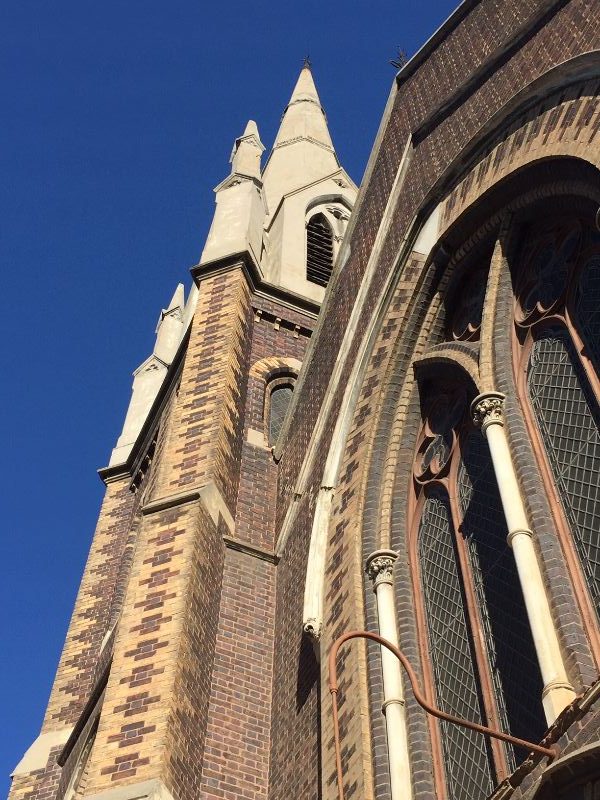
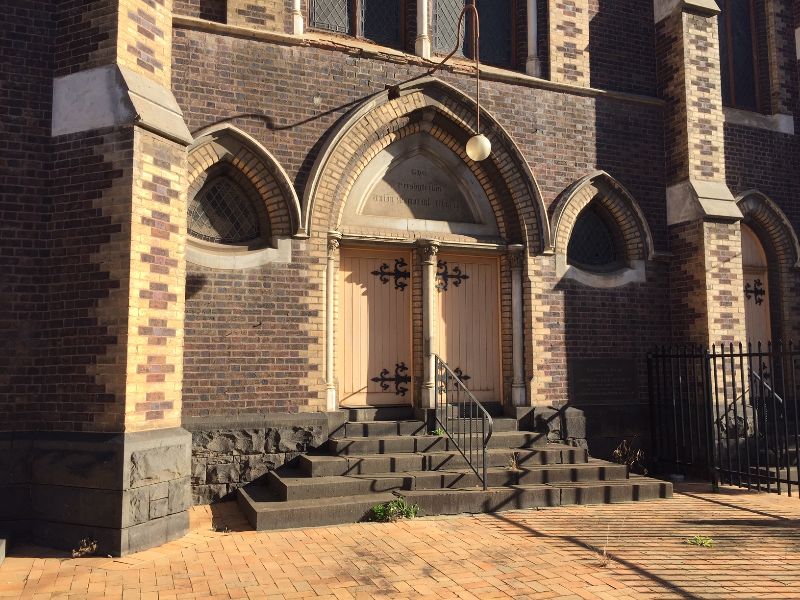
The North Melbourne Uniting church as seen from Curzon Street. Some architectural details are shown below. (All photographs are by Stephen Hatcher.)

It had to come. A cavernous church on a valuable site in the inner city couldn’t be left alone forever before someone realised its sales potential, particularly when that church belongs to the Uniting Church, ever keen to turn its properties into cash. And now this spired and pinnacled edifice in Curzon Street, North Melbourne, has been sold for a reported $10 million.

I am no expert in land values, but that doesn’t sound a very high price for a site of 4822 square metres containing church, hall and manse. But perhaps it’s not such a bargain after all, since the new buyer, who is described as an “overseas investor” – now where do you suppose “overseas” means? – is stuck with a church building protected from substantial alteration by all sorts of “heritage” constraints and which you can’t use for much else. It will be interesting to see in this case whether the heritage constraints extend to internal changes, since being carved up inside into apartments has been the fate of many a large church sold for secular use. The principle seems to be, as with the imposing former Presbyterian churches in East Melbourne, Armadale, Brighton and Moonee Ponds, and quite a few others, that as long as you don’t disfigure the outside too much – a few dormers and solar panels are all right – it doesn’t much matter to the heritage authorities what you do to the inside of an historic erstwhile place of worship.

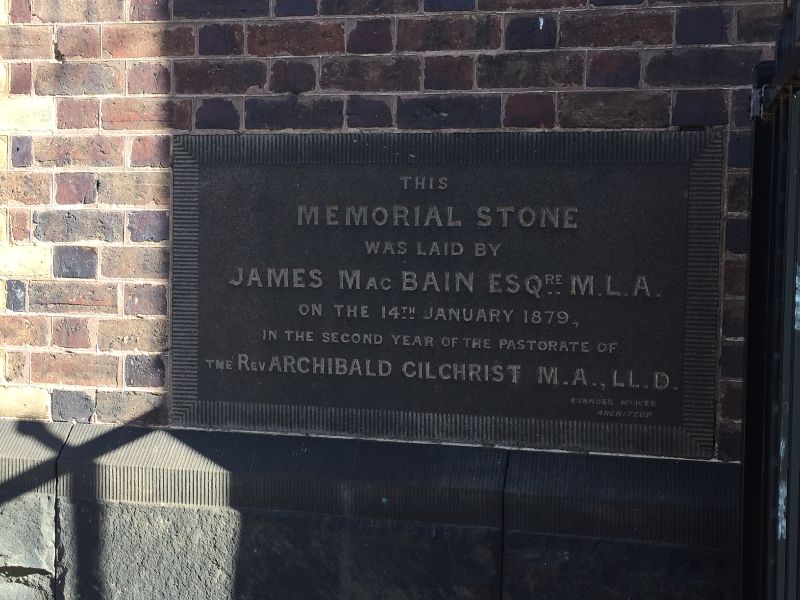
The North Melbourne Uniting church, now known to those who attend it (and are looking for alternative accommodation) as the Congregation of Mark the Evangelist, was built for a Presbyterian congregation in 1878-79. Its official name was the Union Memorial Church, the union commemorated being the formation of the United Presbyterian Church of Victoria from three Presbyterian groups in 1859. The architect was Evander McIver (1834-1902) who arrived in Australia from Scotland at the age of 30 and designed several notable Presbyterian churches, among them Scots’ Church in central Melbourne and St Cuthbert’s, Brighton. The North Melbourne church was designed to hold a congregation of nearly 900 in its wide and lofty nave.

The most prominent feature of the church is its 45-metre tower and spire at the (liturgical) north-west corner. The tower is pinnacled at the corners with large lucarnes – Gothic dormers – on four sides at the base of the spire, which is unusually small by comparison. There are tall pinnacles above the buttresses of the nave and on the low corner tower which flanks the façade of the nave, matching the lower stages of the tower on the other side. The walls are a notable example of polychromatic brick and stonework.

Along with the church, there is an eight-bedroom former manse on the site and two halls, in one of which the political meeting was held in 1955 in which the Labor Party split on the issue of communism, leading to the formation of the Democratic Labor Party two years later.

HOLY NATIVITY, HUGHESDALE

(ANGLICAN)
Poath Road, Hughesdale

Not reopened after the pandemic.

Picture credit: Australian Christian Church Histories. https://www.churchhistories.net.au (08072023)

Holy Nativity Anglican church in Hughesdale was dedicated in 1961 as a chapel of ease (a branch church in effect) in the then well attended middle-class suburban parish of St Peter’s, Murrumbeena. It replaced a smaller timber church subsequently used as a hall. Like other such buildings of its era it was designed to take the pressure of substantial congregations off the parish church. Who could have known, seeing those comfortably filled churches on Sunday morning, the men in suits, the ladies with hats, that catastrophic decline was just around the corner? – largely because the children of the suited and hatted churchgoers, assembled in the Sunday school by parental fiat while their elders sang hymns in church, did not when they came of age follow their parents’ example but gave the practice of religion away.

When that happened, the no longer new churches became redundant, and this seems to have happened with Holy Nativity. I say “seems to” because I have not been able to obtain definite information on the church’s future. Services were suspended in 2020 when the Chinese virus infested our land. They have not been resumed. But no notice board advises on whether services will begin again and no estate agent’s board, with or without the statutory examples of what passes for wit in the world of property dealing – “A Divine Position”, “A Heavenly Opportunity”  announces its impending sale.

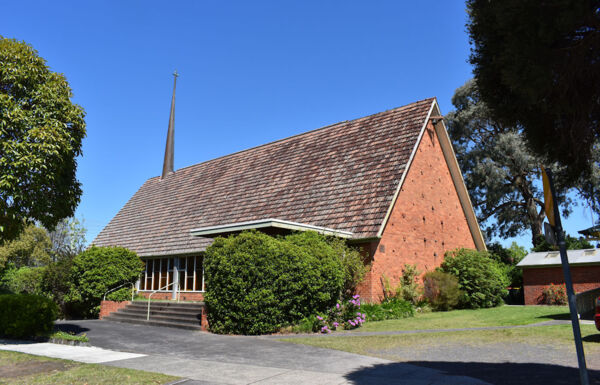
Holy Nativity has no visible foundation stone and the name of the architect is not known. It is a simple honest building, brick, with a steep-pitched tiled roof that covers nave and chancel without distinction. The roof slopes down to low side walls that are glazed for most of their length. The position of the church on a grassy knoll gives it a more commanding presence than it would otherwise have. A thin 30-feet (9.1 metres) metal spire rising from its roof at the altar end is the sole architectural indication of its ecclesiastical function. 

Holy Nativity was well attended until the 1980s when attendances began to fall away. It now is likely to join the list of mid-twentieth century Anglican churches that have shuts their doors in the diocese of Melbourne. The 1950s and 1960s was a time of expansion, now, one by one, the churches built then are going, in districts that were once Anglican heartland: St Stephen’s Darebin, All Saints’ East Malvern, St Mary’s, East Preston, St George’s Bentleigh and Mont Albert and St Martin’s, Deepdene and others. All were attended by vanished congregations that were young when these churches were built, and have since aged and died and not been replaced.

UPDATE

Reader Andrew Scanlon reports that Holy Nativity was closed after a deconsecration service on Christmas Eve 2023 (see Comments). There is no information about the future of the building.

CHURCH OF THE MOTHER OF GOD, IVANHOE EAST

(ROMAN CATHOLIC)
Corner of Wilfrid and Robinhood Roads, Ivanhoe East.

Melbourne’s first church inspired by the Modern movement.

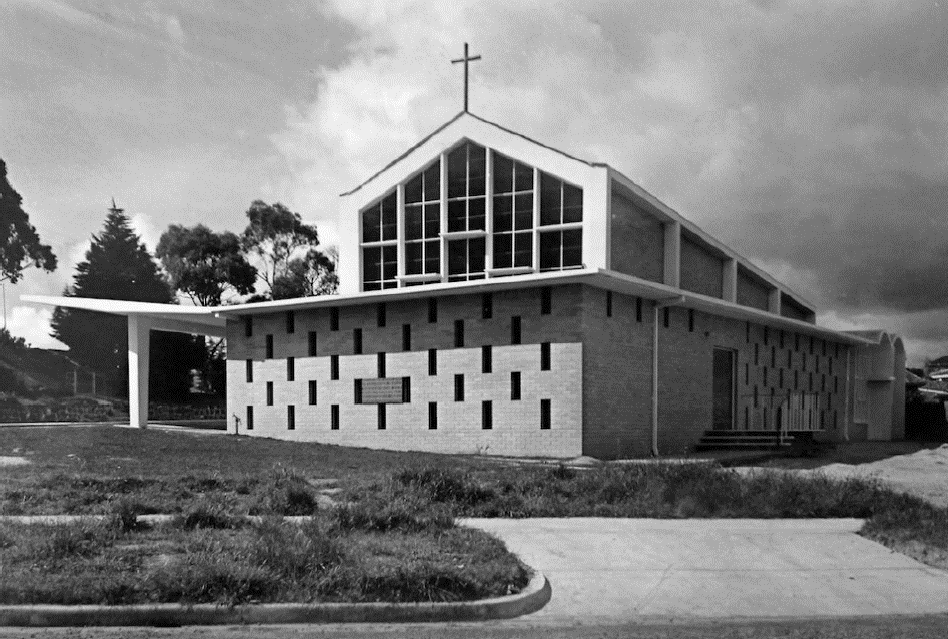
Church of the Mother of God, Ivanhoe East. Note how the steel frame, unusual in church construction in 1956, outlines the façade.

This church has had a very short life, 66 years, just up to the age of being pensioned off.  It was the first Modernist church in Melbourne, the first designed by the firm of Mockridge, Stahle and Mitchelland is now the first of their ecclesiastical buildings to be shut down and sold. 

Outright closure is still unusual for Roman Catholic churches, whose congregations, if diminished, seem never to peter out like those of non-RC denominations. In this case there has been a union of parishes, an increasingly frequent phenomenon given the shortage of priests. The East Ivanhoe parish of the Mother of God has been united with the Ivanhoe central parish and the former church and its school are redundant. The local state school has the school and the church is on the market.

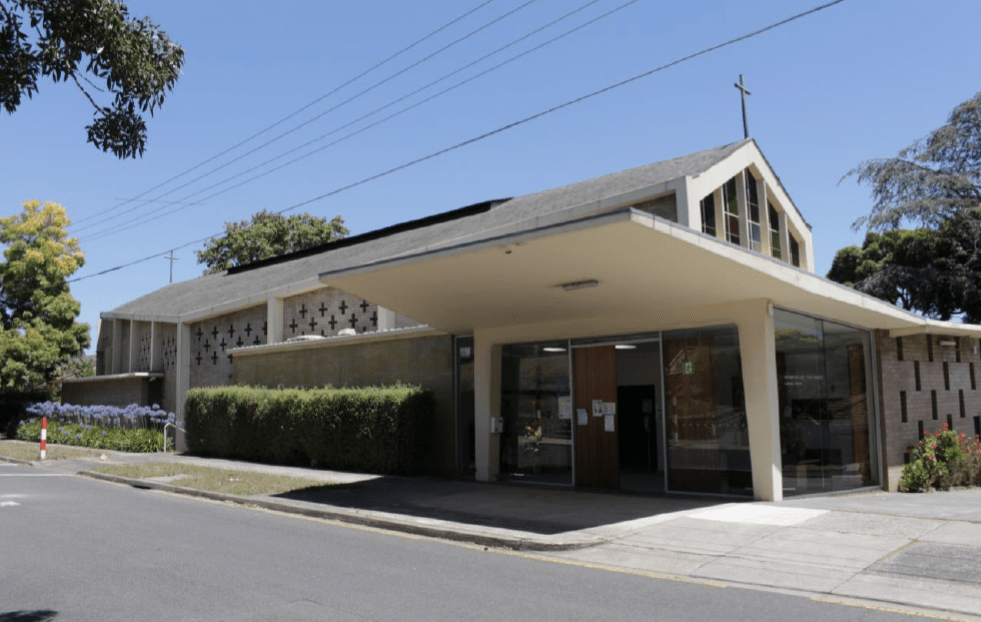
Porch and main entrance of the church. The upward sweep of the cantilever, that covers the public footpath,
was a very ultra-modern touch when the church was built. 

It’s a very characteristic church of its era, with a nave and sanctuary in conventional linear form where the pews all look towards the altar. Had it been built a decade or two later it would have been designed “in the round”, with the altar brought closer to a surrounding congregation as recommended by the Second Vatican Council. As it is, it is a traditional church in the contemporary dress so avant-garde at the time. The decision to build in the modern idiom, at a time when Neo-Romanesque Catholic churches were still being built, was an unusual one.   

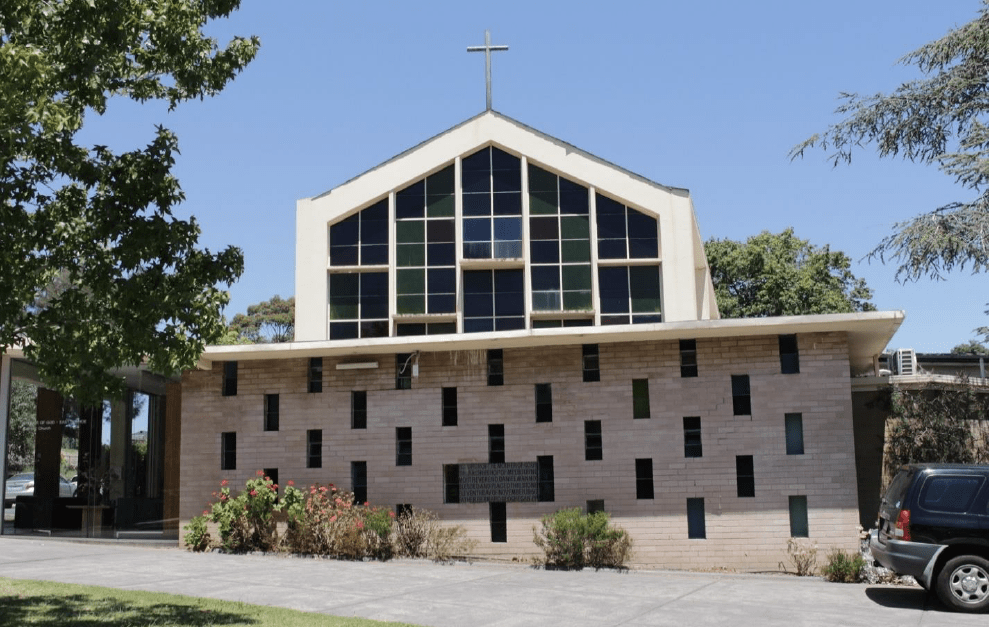
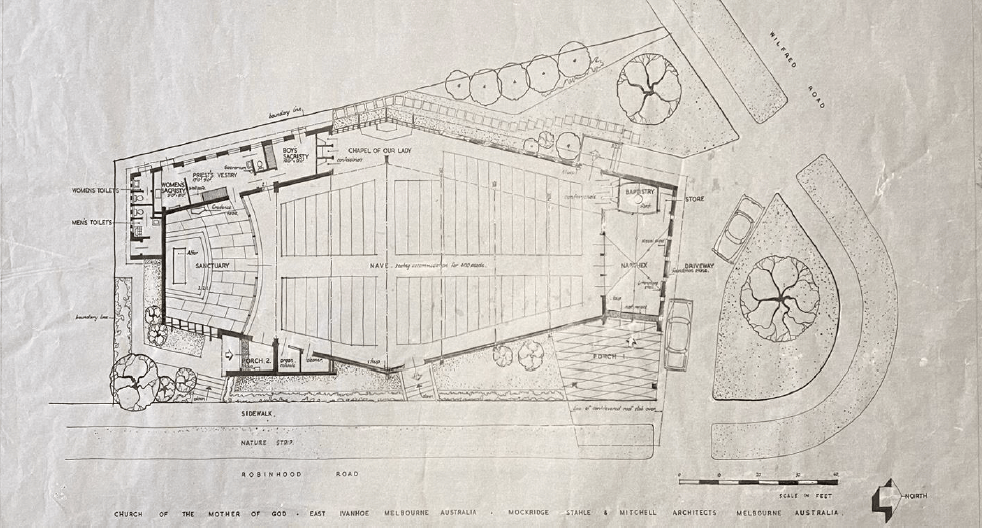
The main part of the building is in the form of a lozenge in plan so that the sides of the nave project slightly outward and the edge of the roof dips in the middle. The roof is of slate with a gable at each end and copper cross, and a vent along it that has the effect of emphasising the long line of the ridge. The concrete frame, painted white, stands out clearly on the façade, and on the side elevations, where it has the effect of a loggia. On the geographical east side the upper part of the middle four bays is pierced by rows of small cruciform clear-glass windows. There is also a section of window wall in random geometric shapes, which lighting the sanctuary, is filled with stained glass in primary colours. There is further stained glass in the window wall of the north-facing (liturgical west) gable. Beneath that is a narthex, its front wall pierced by five alternating rows of narrow rectangular windows. The narthex roof extends to the north, where it is cantilevered over the public footpath to form an entrance porch. The upward sweep of the cantilever was a very ultra-modern touch in 1956. 

The lozenge-shaped plan of the church with the sanctuary at the left.

A low wing with the Lady Chapel and sacristy and other accommodation extends along part of the geographical west and south sides of the church. It is flat-roofed apart from four barrel vaults over the chapel. 

The sanctuary of the church of the Mother of God as it was at the time of opening in 1957. The altar and communion rails were subsequently removed.
The nave when new. The Lady Chapel is at right.

The foundation stone of the Mother of God church was blessed by Archbishop Mannix on 11 November 1956. The Advocate newspaper carried a detailed description of the new building in its report.

Side view of the church of the Mother of God. The uprights of the concrete frame stand out clearly and have the effect of a loggia.

“The church will be a steel framed building with the structural members clothed in pre-cast concrete to facilitate speedy erection and precision finish. Infill walls will be of pink-fawn Colortone bricks and the roof is to be of slate. The architects, Mockridge, Stahle and Mitchell, have pursued an unusual lozenge form which was suggested by the wedge-shaped site. The exaggerated perspective produced by this shape will lead the eye directly to the high altar…”

The church under construction in 1957.
It was the first Modernist church in Melbourne.
The church was the first designed by the firm of Mockridge, Stahle and Mitchell, who went on to become leading interpreters of Modernism. (Picture: Peter Wille, State Library of Victoria, no a22359.)

“The church which is designed to seat 450, will sit on a concrete mat to be covered with lino tiles. Rich colour will be introduced on the plastered walls whilst dado and ceilings will be in hardwood lining boards waxed in their natural colour. Pews also will be constructed of this timber. Italian glass mosaics will be used to sheath four columns which occur between the nave and the aisle. The Lady Chapel, which is part of the nave, will be emphasized by the barrel vaulting of the ceiling, and plastic domes in the flat roof will flood the baptistry and the centre of the narthex with light. A priest’s vestry, boys’ sacristy and women’s sacristy for flower arranging are also provided.”

All this was built as described and externally the church remains pretty much as it was when it was opened in September 1957. Internally, though, there have been some changes. The high altar, to which the unusual interior perspective, according to the Advocate, led the eye, was removed, along with the delicately coloured tiled wall behind it and the communion rails, during the post-Vatican II mania for “reordering” sanctuaries and a wooden altar like a butcher’s block substituted. Still in place are a crucifix and Stations of the Cross made for the church by Silesian-born woodcarver Hermann Hohaus (1920-1970).

The new church was favourably received in architectural circles, not least by the relentlessly Modernist architecture faculty at the University of Melbourne whose newsletter commented favourably on the architects’ “uncommon departure” from usual church design, which it damned as the “architecturally most backward building type in Australia”. Mockridge, Stahle and Mitchell (the firm was active from 1948 to about 1983) went on to become leading interpreters of the Modern movement. As well as the Mother of God they designed St Faith’s, Burwood, in Melbourne’s eastern suburbs and the unfortunately not very attractive Religious Centre at Monash University, which looks like an upturned jelly mould. They also specialised in educational buildings. 

It will be interesting to see whether the closure of the Mother of God is the start of a process of “rationalisation” of smaller churches in the Catholic archdiocese of Melbourne such as is already happening in the Anglican diocese and, much more widely, across country Victoria. It will be interesting as well to see whether some way is found of preserving this church – perhaps as one of the growing number of ethnic places of worship – or whether its wedge-shaped site will be seen as just the place for yet more “town houses”.   

UPDATE JULY 2023
Not town houses but one house. The erstwhile Mother of God is to be turned into a private dwelling. The one thing one can say in favour is that its exterior, which will be preserved, is less unsuitable for this than that of other churches that have been similarly converted.

UPDATE JULY 2024

The good news is that this church will be kept as a place of worship. It has been sold on to a body called the Saints’ Church Melbourne (https://saints.org.au/) and will be used by its congregation.

The Mother of God church when new. Sixty-five years later it is surplus to parish requirements.

Grateful acknowledgment is made of photographs and information in the Banyule Heritage Study, 2020.