(ANGLICAN)
CROMWELL ROAD, HAWKSBURN
A fine nineteenth-century church on a hill in inner Melbourne. But how secure is its future?
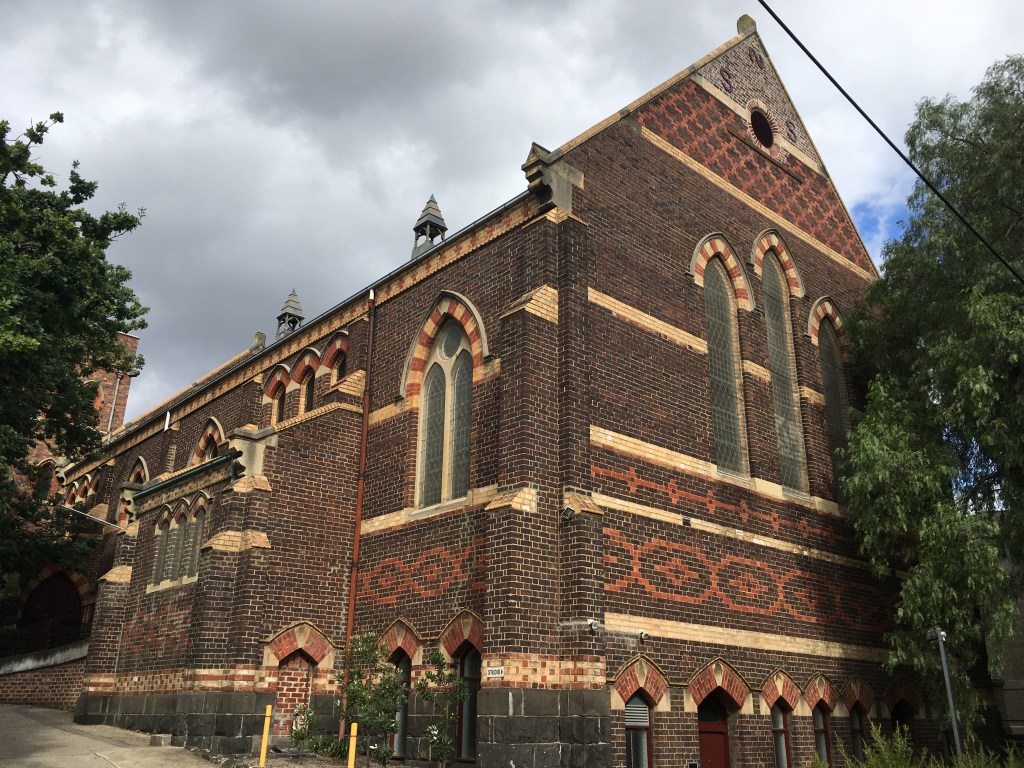
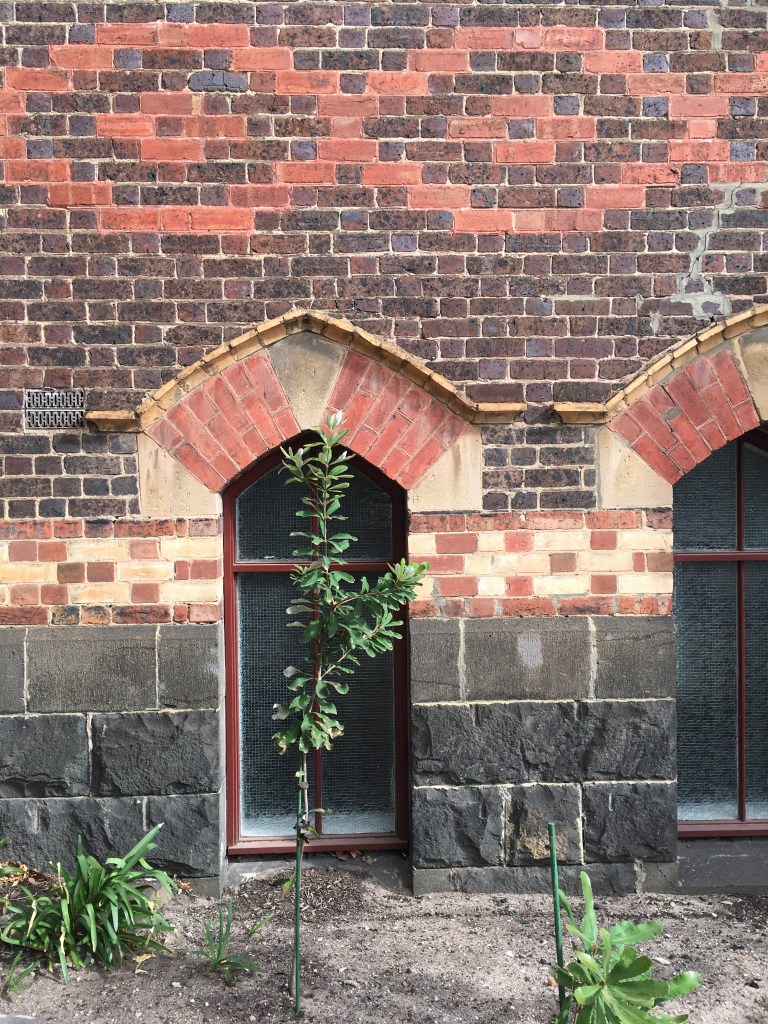
St Martin’s is a lofty barnlike church with some nice decorative details. The walls are in polychrome brick, partly diaper-patterned. The wide apse has a three-light traceried window at the east, set into its own gable raised above the wall level like a dormer. Three little lanterns on the roof ridge for ventilation give a jaunty touch.
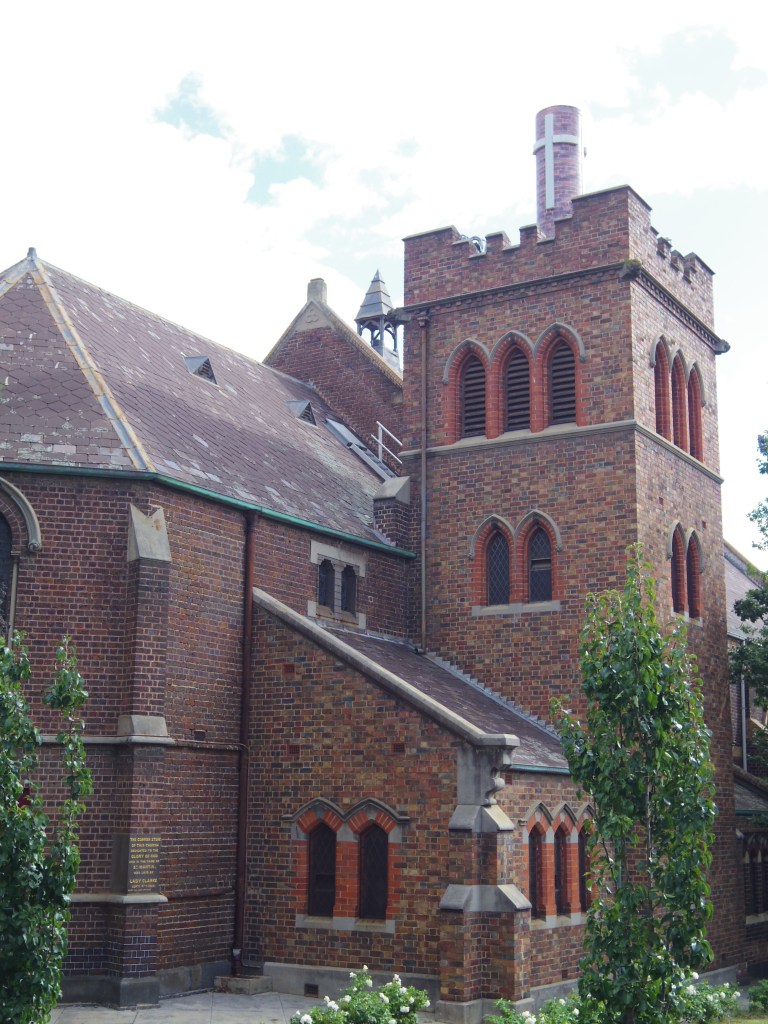
St Martin’s was built between 1883 and 1887 to designs by Edmund G. Ovey (c. 1847-1916) who designed a number of buildings in the surrounding district, including his own house in Cromwell Road and the vicarage at St Martin’s. The five-bay nave is wide and without side aisles but with side porches, the chancel has lean-to vestries, there is a short right transept. The low square tower with three bell openings on each side and crenellated parapet was added in 1922. The architects were the partnership of A. &. K. Henderson, Rodney Alsop and Marcus Martin, all big names in their profession.
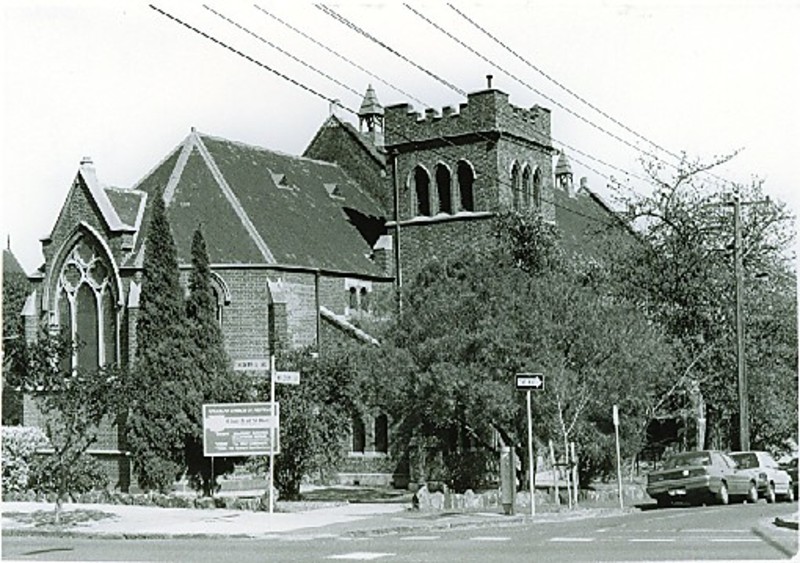
The land beneath the church falls away steeply to the west; seen from down the street looking uphill St Martin’s looks like a Victorian church in London. The west front has three lancet windows. There is a crypt under the west end of the nave, used for various events. The western bay of the nave has been divided off internally to accommodate two levels of meeting rooms. You can see desks and chairs and other paraphernalia through the glazed partitions.
St Martin’s contains some fine stained glass, a well restored and elaborately stencilled Fincham organ of 1887 and all of its original timber fittings, including an oak altar carved by the renowned Robert Prenzel (1866-1941). The open screen across the narthex is a later insertion. The spacious chancel looks all the wider without the choir stalls that were once on either side (few Anglican chancels in Melbourne have choir stalls any more, partly through a dearth of choristers, partly because, as at St Martin’s, the space has been conscripted to accommodate forward-standing altars in the post-Vatican II RC tradition). St Martin’s is in the Anglo-Catholic tradition of Anglicanism with various High Church indicators inside such as that sine qua non, six candles on the altar, though the raked floor of the nave gives it an Evangelical look, like St Jude’s, Carlton, or the former nave at St Matthew’s, Prahran.
St Martin’s is open all day, now a rarity among Melbourne Anglican and RC churches that were once invariably open. Daily accessibility is one of several signs that determined efforts are being made to attract more people into St Martin’s and to anchor it in the local community.
Hawksburn has always been mixed in character: the streets downhill from St Martin’s towards Chapel Street were once working-class, those higher up comfortably upper middle-class with many fine houses. Their original owners were probably churchgoers in the main but current residents don’t seem to have the time or inclination for that and the congregation of St Martin’s is small. This puts the church at risk as not being financially “viable”. Location is not in its favour either. St Martin’s sits roughly half-way between the two high-profile Anglican parishes of St John’s, Toorak, and Christ Church, South Yarra. If it were to be closed it would be a definite architectural loss but its parishioners would still not have far to travel to church.
UPDATE 26 JUNE 2024
How secure is the future of this church? we asked above. Quite secure it now seems. Please see comments below.
PHOTOGRAPHY FOR THIS POST BY ANTHONY BAILEY unless noted.
 HERE TODAY...
Fortunately, post-COVID there has been a significant increase in attendance at St. Martin’s Hawksburn. The Parish is financially viable, and now sustainable based on the numbers in the pews. Recent structural improvements to the church building have also taken place, including the replacement of the slate roof in the sacristy, and major works to improve drainage around the site to stop rising damp in the southern and western walls, as well as stripping back acrylic paint through most of the interior and the application of chemical waterproofing in the southern stairwell. The Fincham organ (featured in the Dec 2023 OHTA journal) has been well maintained and is regularly tuned. A St. Martin’s Music Foundation has also recently been established, and there are now three clergy (two of which are honorary) who preach and celebrate. Vicar – Fr John Raike
LikeLike